Mass casualty and disaster response
Stem
At 4:30 p.m. on a weekday, a bomb explodes at a crowded stadium 3 km from your hospital. The emergency department expects more than 40 casualties, the first arriving within minutes. Twelve operating rooms are running elective cases, four of them near closing. You are the anesthesiologist in charge of the operating rooms, and the hospital has just declared a mass casualty incident.
Question
What do you do as the anesthesiologist running the operating rooms?
Ideal answer
HeadlineI join the hospital incident command as OR medical director, stop new elective starts, and turn the OR into damage-control capacity.
- Plug into command. With the OR nursing manager, I report OR status to the hospital command center and take direction through one chain.1
- Create capacity. Hold elective cases, finish open ones fast, staff ORs for 0–2, 2–12 and 12–24 hours, and speed PACU transfers out.1
- Send an anesthesiologist to the ED as liaison, plus stat teams for airways elsewhere in the hospital.1
- Damage control, blood ready. Surgeons do damage-control surgery; the blood bank confirms supplies and issues universal products.1
- Expect the wave. About half the casualties arrive within an hour, the less injured first; the sickest come later.2
Breaking down the answer
- The command structure — HICS puts operations, planning, logistics and finance/administration sections under one incident commander;3 each person reports to one supervisor with 5–7 direct reports.1 Changes if: my span grows past seven; I appoint team leaders.
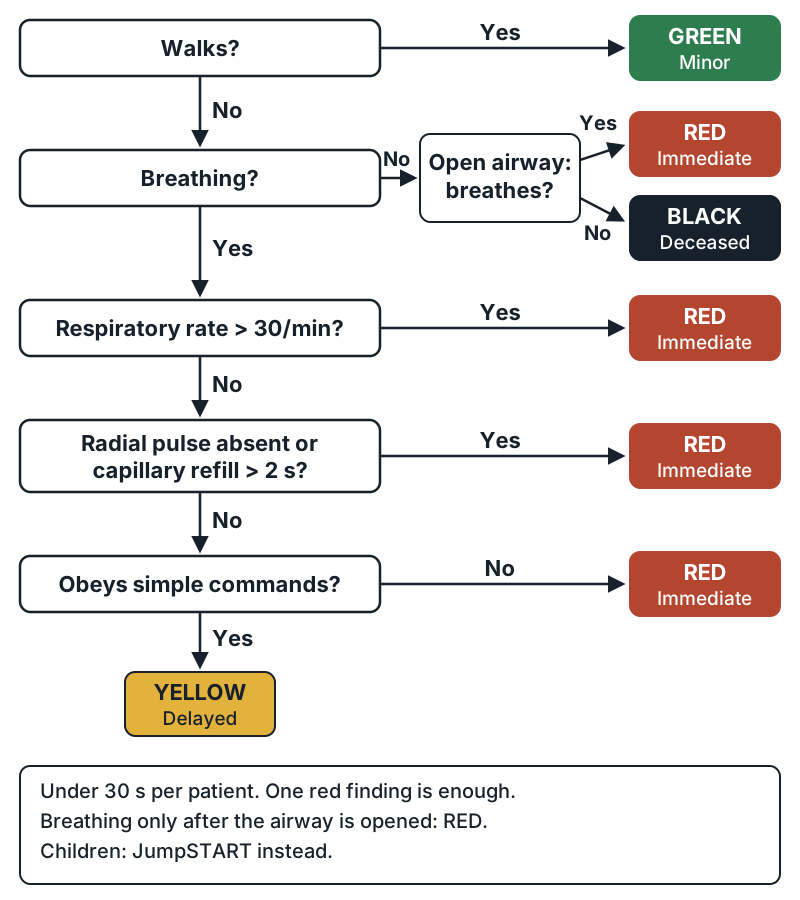
- START in under 30 seconds — walking is minor; apnea after airway repositioning is deceased; respiratory rate over 30, absent radial pulse or capillary refill over 2 seconds, or not obeying commands is immediate; otherwise delayed.4 Changes if: a child; JumpSTART applies.1
- SALT adds interventions — a global sort by walking, waving or still, then lifesaving interventions: hemorrhage control, airway opening, chest decompression, autoinjector antidotes.5 Changes if: survival is unlikely with available resources; the patient is expectant.6
- Blast injury patterns — primary from overpressure (eardrum rupture, blast lung, air embolism), secondary from fragments, tertiary from being thrown, quaternary from burns, crush and toxins.2 Changes if: blast lung; cautious positive pressure, as rupture and air embolism follow.2
- Radiation is rarely the emergency — life-threatening injuries are stabilized before decontamination; removing clothing removes up to 90% of external contamination; staff in protective equipment face little risk.7 Changes if: early vomiting; serious exposure, followed with serial lymphocyte counts.7
- Protective equipment by level — Level A is a supplied-air respirator in an encapsulating suit; Level C an air-purifying respirator when the agent is known; Level D a work uniform.8 Changes if: the agent is unknown; a higher level until identified.
Follow-up question
Twenty minutes later, eight people arrive from a subway station near the stadium with pinpoint pupils, drooling, wheezing and muscle twitching. Two are apneic. What do you do?
Follow-up answer
HeadlineThis is nerve agent exposure. I tell the room, and staff protection and decontamination come before treatment inside.
Apneic and severe patients get three DuoDote autoinjectors immediately in the decontamination corridor from protected staff,9 while clothing comes off and skin is washed with soap and water.10 Then IV atropine, doubled every 3–5 minutes until secretions dry, pralidoxime and benzodiazepines for seizures.10 The apneic patients are intubated with rocuronium, not succinylcholine, whose paralysis is markedly prolonged with cholinesterase inhibited, expecting high airway pressures from bronchorrhea. I reassess secretions and oxygenation every few minutes.
Pitfalls that cost points
- Letting contaminated patients into the OR suite; one exposed team closes rooms.
- Spending scarce ORs on definitive repairs while bleeding patients wait.
- Forgetting tomorrow: no relief rota for the 12–24-hour block.
Rapid-fire
Q: What is the most common primary blast injury? A: Tympanic membrane rupture, with hearing loss, tinnitus or ear pain at presentation.2
Q: How late can blast lung appear? A: Usually at first evaluation, but as late as 48 hours.2
Q: What is in a DuoDote autoinjector? A: Atropine 2.1 mg and pralidoxime chloride 600 mg; at most three per patient.9
Q: When is radiation decontamination complete? A: When readings are no more than twice background, or stop changing.7
Q: What share of arriving casualties need immediate care? A: About 20% in a survey of 20 incidents.1
Numbers to know
| Item | Value |
|---|---|
| START per patient | ≤30 s4 |
| START immediate | RR >30, cap refill >2 s or no radial pulse, not obeying4 |
| Casualties arriving in the first hour | About 50%2 |
| OR staffing blocks | 0–2, 2–12, 12–24 h1 |
| Span of control | 5–71 |
| Clothing removal | Up to 90% of external contamination7 |
| DuoDote, severe symptoms | 3 autoinjectors at once9 |
Links
- Trauma: initial management and damage control, Massive hemorrhage and transfusion, burns, The poisoned patient: toxidromes and antidotes, Venous air embolism and the sitting position
- Hospital Incident Command System Guidebook; CHEMM and REMM (HHS) resources
Sources
- 1.Disaster preparedness · OpenAnesthesia (IARS) · openanesthesia.org
- 2.Essential Blast Injury Facts (CDC blast injury fact sheets) · ACEP / CDC · acep.org
- 3.Hospital Incident Command System Guidebook, Fifth Edition · California Emergency Medical Services Authority, 2014 · emsa.ca.gov
- 4.Simple Triage and Rapid Treatment (START), Policy 7508 · Sacramento County EMS Agency, 2023 · dhs.saccounty.govEffective May 1, 2023; restates the standard START adult algorithm.
- 5.SALT Mass Casualty Triage · HHS CHEMM · chemm.hhs.gov
- 6.START Adult Triage Algorithm (text version) · HHS CHEMM · chemm.hhs.gov
- 7.Just-in-Time Training for Hospital Clinicians (radiation emergencies) · CDC · cdc.gov
- 8.Rescuer Safety: Personal Protective Equipment · HHS CHEMM · chemm.hhs.gov
- 9.DuoDote (atropine and pralidoxime chloride) Prescribing Information · Drugs.com (FDA label) · drugs.com
- 10.Organophosphate poisoning · OpenAnesthesia (IARS) · openanesthesia.org
Facts on this page were checked against these sources on Oct 22, 2026. Guidelines change; confirm doses against current institutional protocols.