Massive hemorrhage and transfusion
Stem
A 28-year-old man, 85 kg, arrives in the operating room 40 minutes after a gunshot wound to the abdomen for an emergency laparotomy. He has one 18-gauge IV and has received 1 L of crystalloid. Blood pressure is 74/40 and heart rate 138. He is awake but confused. On opening, the surgeon finds a large retroperitoneal hematoma and says, "I can't see anything."
Question
How will you resuscitate this patient?
Ideal answer
HeadlineMassive hemorrhage is resuscitation and surgery at once: I call for help and activate the massive transfusion protocol now, anticipating bleeding.
- Two large-bore IVs or rapid-infuser sheath, arterial line, placed while the surgeon gains control.
- Stop crystalloid; 1:1:1 plasma, platelets, red cells, warmed, via rapid infuser, uncrossmatched O-positive first because he is unstable.
- Tranexamic acid, within three hours of injury: 1 g over 10 minutes, then 1 g over 8 hours.1
- Gas, ionized calcium, potassium, fibrinogen, viscoelastic test every 30 minutes, because citrate and dilution shift them; calcium chloride 1 g, repeated,2 for ionized calcium 1.1–1.3 mmol/L;1 cryoprecipitate or concentrate for fibrinogen 150 mg/dL or less.
- Systolic 80–90 mmHg until bleeding is controlled,1 then normal; targeted replacement once results return.
Watch for: temperature, and bleeding despite ratios: coagulopathy or surgery, not red cells.
Breaking down the answer
- Activate the protocol early — ACS TQIP triggers: an ABC score of 2 or more, persistent instability, or transfusion in the trauma bay,3 or simply the surgeon saying they cannot see. Delay means plasma and platelets arrive after the coagulopathy is established.
- Ratios before labs, then labs before ratios — 1:1:1 approximates whole blood and prevents dilutional coagulopathy; in PROPPR it achieved hemostasis more often than 1:1:2 without changing overall mortality.1 Empiric plasma in a patient who needs fibrinogen wastes time and volume.
- Permissive hypotension — a mean of 50–60 mmHg or systolic 80–90 limits clot disruption and dilution until hemostasis. Changes if: brain or spinal cord injury, holding a MAP of at least 80 mmHg in severe brain injury,1 and the elderly or coronary patient.
- Calcium early and repeatedly — citrate binds ionized calcium, a liver in shock and hypothermia cannot clear it, causing hypotension and a coagulopathy no plasma fixes. Ionized calcium 1.1–1.3 mmol/L with calcium chloride, three times the elemental calcium of gluconate.1
- Why within 3 hours — in CRASH-2 tranexamic acid cut bleeding deaths most within 1 hour (RR 0.68), less at 1–3 hours, and after 3 hours increased them (RR 1.44), so I do not give it late.4
- Avoid crystalloid — every liter dilutes clotting factors, cools the patient and worsens acidosis. Blood replaces blood.
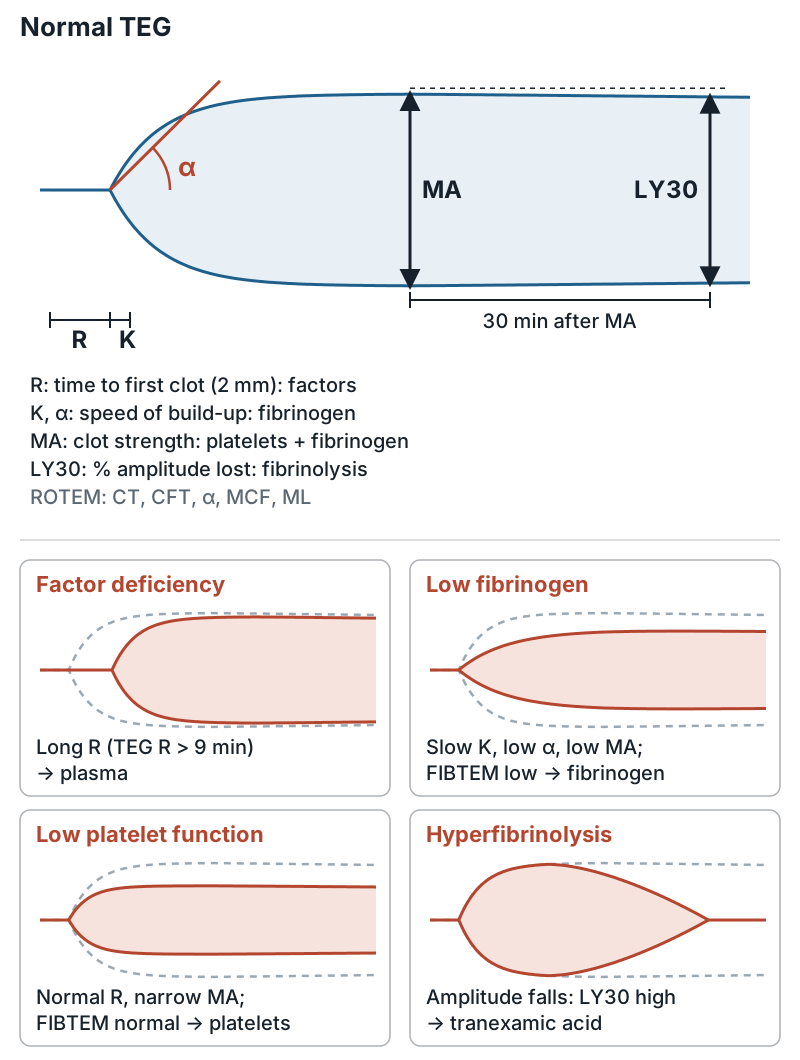
- Fibrinogen is the first factor to fall — I also replace it when the viscoelastic clot amplitude is low, starting with 3–4 g: 15–20 single-donor units of cryoprecipitate or 3–4 g of concentrate.1
Follow-up question
The surgeon has control of the bleeding, but the pressure is 70/40 and the ECG now shows peaked T waves. What is happening, and what do you do?
Follow-up answer
HeadlineTransfusion hyperkalemia and hypocalcemia together, the two electrolyte killers of rapid transfusion. I tell the team.
Calcium chloride 1 g first, because it stabilizes the myocardium and corrects the hypocalcemia at once; then insulin 10 units with dextrose 25 g, bicarbonate if acidotic, and hyperventilation. I check the gas and the potassium, switch to the freshest red cells available, and ask the blood bank for washed units, which remove most of the supernatant potassium, if the transfusion will continue.5 I recheck potassium and ionized calcium every 15–30 minutes until the ECG normalizes.
Pitfalls that cost points
- Resuscitating to a normal pressure before the surgeon has control, then being asked why the patient rebled.
- Forgetting calcium, or stating it without a target and a dose.
Rapid-fire
Q: Why does banked blood cause hyperkalemia? A: Stored red cells leak potassium about 1 mEq/L per day, toward a plateau near 60 mEq/L;5 the dose matters only with rapid infusion, in children and in renal failure.
Q: What is the lethal triad? A: Hypothermia, acidosis and coagulopathy, each driving the others; enzyme function falls about 10% per degree,1 and acidosis further impairs platelets and clotting enzymes.
Q: When do you give uncrossmatched blood? A: Immediately when the patient is unstable; O-negative for women of childbearing potential (under about 45–50), O-positive for everyone else,3 and type-specific as soon as the bank can issue it.
Q: What does a viscoelastic test add? A: A faster whole-blood picture: clotting time for factors (ACS TQIP gives plasma for a TEG R time above 9 minutes),3 clot amplitude for fibrinogen and platelets, lysis for hyperfibrinolysis justifying tranexamic acid.
Q: An hour later he is hypoxic with frothy secretions; how do you separate TACO from TRALI? A: By the filling pressures and the response to diuretics; I treat both with oxygen and lung-protective ventilation.
Numbers to know
| Item | Value |
|---|---|
| Massive transfusion definition | > 10 units of red cells in 24 h3 |
| Product ratio | 1:1:1 plasma:platelets:red cells; ACS TQIP accepts plasma:RBC 1:1 to 1:23 |
| Tranexamic acid | 1 g over 10 min, then 1 g over 8 h, within 3 h1 |
| Ionized calcium target | 1.1–1.3 mmol/L; calcium chloride preferred1 |
| Fibrinogen trigger | ≤ 150 mg/dL; initial 3–4 g (15–20 single-donor cryo units)1 |
| Permissive hypotension | Systolic 80–90 mmHg; MAP ≥ 80 in severe brain injury1 |
Links
- Trauma: initial management and damage control, Perioperative hypothermia and coagulopathy, Transfusion reactions, TRALI and TACO, dic, Obstetric hemorrhage: previa, accreta, atony, hyperkalemia
- ASA Practice Guidelines for Perioperative Blood Management; ACS TQIP Massive Transfusion in Trauma Guidelines
Sources
- 1.The European guideline on management of major bleeding and coagulopathy following trauma: sixth edition · European multidisciplinary task force (Crit Care), 2023 · pmc.ncbi.nlm.nih.gov
- 2.Best practices on blood and blood products for a prehospital hemorrhage protocol: consensus from the 2025 Canadian prehospital transfusion summit · Scandinavian Journal of Trauma, Resuscitation and Emergency Medicine (Peddle et al.), 2026 · europepmc.orgRoutine calcium chloride 1 g IV or calcium gluconate 3 g IV at regular intervals, at minimum after the second unit transfused.
- 3.ACS TQIP Massive Transfusion in Trauma Guidelines · American College of Surgeons, 2014 · ww2.facs.orgRe-read 2026-11-02 (released October 2014): triggers ABC score >=2, persistent instability, transfusion in the trauma bay; plasma:RBC 1:1 to 1:2; O-negative reserved for women of child-bearing potential (under 45-50); plasma for TEG R >9 min; massive transfusion >10 RBC units/24 h. No later ACS massive transfusion guideline found; the European 2023 guideline is the newest guideline cited.
- 4.The importance of early treatment with tranexamic acid in bleeding trauma patients: an exploratory analysis of the CRASH-2 randomised controlled trial · The Lancet, 2011 · researchonline.lshtm.ac.uk
- 5.Transfusion-Associated Hyperkalemic Cardiac Arrest in Neonatal, Infant, and Pediatric Patients · Frontiers in Pediatrics (PubMed Central), 2021 · ncbi.nlm.nih.gov
Facts on this page were checked against these sources on Oct 14, 2026. Guidelines change; confirm doses against current institutional protocols.