Anticipated difficult airway and the ASA algorithm
Stem
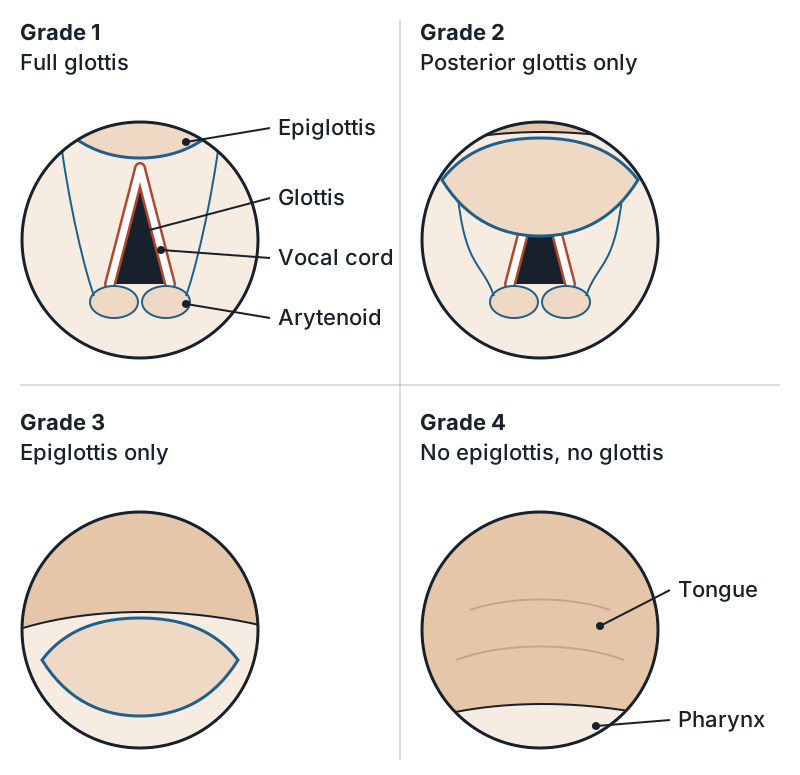
A 54-year-old woman, 84 kg, is scheduled for an elective total thyroidectomy for a multinodular goiter without tracheal compression on CT. A note from her hysterectomy five years ago reads "grade 3 view, intubated on the second attempt with a bougie." She has a receding mandible, Mallampati 3, a thyromental distance of 5 cm and full neck extension. She has no beard, no snoring, no reflux and a normal mouth opening.
Question
How will you plan to secure her airway?
Ideal answer
HeadlinePredicted difficult laryngoscopy but nothing predicts difficult oxygenation, so I induce her rather than intubate awake, video laryngoscope first.
- Assess four things first. Difficult laryngoscopy, mask ventilation, supraglottic airway placement, front-of-neck access: no beard, no sleep apnea, good mouth opening, and the goiter not compressing her trachea.
- Supraglottic airway and flexible scope opened, colleague present, so plan B is in hand.
- Preoxygenate to end-tidal oxygen fraction about 0.9, nasal oxygen through the attempt, for the longest safe apnea.
- Full intubating dose of rocuronium, sugammadex drawn up; three laryngoscopy attempts, a fourth only by a more experienced colleague; I declare failure early.1
- Before induction, I state my exit aloud: supraglottic rescue, wake her if I can, front-of-neck access if I cannot oxygenate; cricothyroid membrane marked beforehand.
Watch for: oxygen saturation; it, not the view, decides the next step.
Breaking down the answer
- Awake versus asleep — judgment first. Awake when difficult intubation comes with difficult ventilation, high aspiration risk, intolerance of even brief apnea, or expected difficult front-of-neck rescue: breathing guarantees oxygenation.2 Changes if: uncooperative patient, child or bleeding airway, then an induction preserving spontaneous breathing.
- Preoxygenation and apneic oxygenation — good preoxygenation extends safe apnea in a healthy adult from 1–2 minutes to as long as 8; nasal oxygen at up to 15 L/min during laryngoscopy prolongs it further;3 high-flow nasal oxygen is an alternative.2
- Video laryngoscopy first — in predicted difficult airways it gives better views and more successful intubations than direct laryngoscopy;2 a hyperangulated blade with a styleted tube suits an anterior larynx.
- Why stop at three — each attempt adds edema and bleeding; then I declare failed intubation and move to a second-generation supraglottic airway or wake the patient.1 Between attempts I change operator, blade, position or relaxant.
- Full relaxation — rocuronium 1.2 mg/kg,4 because a paralyzed patient is easier to intubate and mask, and further attempts should not proceed without full block.3 Sugammadex 16 mg/kg is the labeled dose for reversal soon after that dose.5
- Use the structure, do not recite it — the 2022 ASA guidelines give the framework; the examiner wants it applied to this patient (organization).2
Follow-up question
You induce her and the video laryngoscope shows only epiglottis, with blood in the pharynx after the first attempt. The saturation is 95%. What do you do?
Follow-up answer
HeadlinePlan A is failing: epiglottis only and blood after one attempt. I call for help and say so.
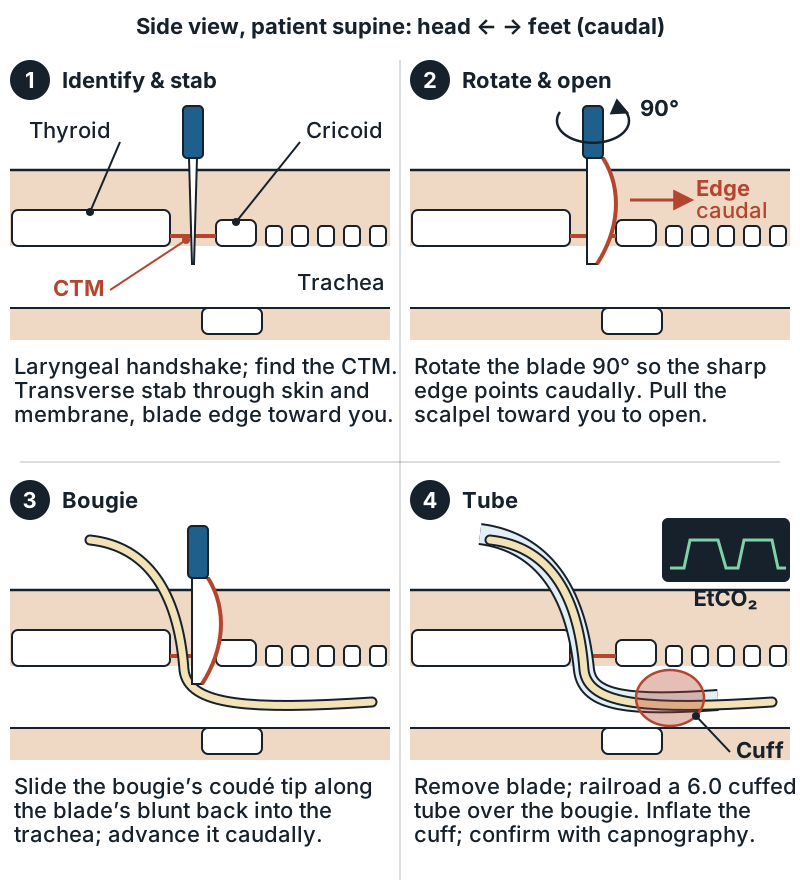
Two-hand mask ventilation, oral airway in, saturation above 90% before another attempt. Attempt two changes the tool: a bougie under direct view, or a hyperangulated blade with suction, with her repositioned. If that fails, I place a second-generation supraglottic airway, ventilate, and decide: wake her with sugammadex, because this surgery is elective, or intubate through it with a flexible scope if surgery could not wait. If at any point I cannot oxygenate, I stop troubleshooting and perform a scalpel-bougie cricothyrotomy, saying so before the saturation forces it. Afterward I document, tell her and register the airway.2
Pitfalls that cost points
- Reciting the algorithm as a flow chart instead of applying it to the patient in the stem.
- Choosing asleep intubation with stridor or a fixed obstruction because "video laryngoscopy usually works".
- "Keeping it light": a half-relaxed patient is the worst of both worlds, harder to intubate and to mask.
Rapid-fire
Q: Why not a flexible scope asleep with a large tongue-base tumor? A: Induction removes pharyngeal tone and the tumor obstructs completely; awake, the patient maintains the only airway that exists.
Q: What predicts difficult mask ventilation? A: Beard, BMI above 30, age over 55, edentulous, snoring or sleep apnea, Mallampati 3–4, and neck radiation; no single one is reliably more predictive,2 so two or more raise my threshold for inducing.
Q: When is a supraglottic airway the wrong rescue? A: Fixed obstruction at or below the glottis, mouth opening below 2 cm, and a full stomach, where it buys oxygenation but not protection.
Q: Why does sugammadex not solve a cannot-oxygenate situation? A: Reversal takes minutes and does not guarantee a patent airway1 or spontaneous ventilation;3 with no oxygen reserve, that is time I do not have.
Numbers to know
| Item | Value |
|---|---|
| Preoxygenation target | End-tidal O2 fraction 0.87–0.93 |
| Apneic oxygenation | Nasal cannula up to 15 L/min, or HFNO |
| Laryngoscopy attempts | 3, plus 1 by a more experienced operator1 |
| Rocuronium for intubation | 1.2 mg/kg |
| Sugammadex for immediate reversal | 16 mg/kg5 |
| Mouth opening for supraglottic airway | ≥ 2 cm interincisor |
Links
- Cannot intubate, cannot oxygenate, Awake fiberoptic intubation: topicalization and sedation, Rapid sequence induction and full stomach, Extubation of the difficult airway, Obstructive sleep apnea
- Atlas: VL, SGA, FOB, lung isolation, cricothyroidotomy, exchange catheter, jet ventilation; Airway ultrasound structures (2027)
- ASA Practice Guidelines for Management of the Difficult Airway (2022)
Sources
- 1.Difficult Airway Society 2025 guidelines for management of unanticipated difficult tracheal intubation in adults · DAS, 2025 · sea.org.ecAhmad et al., Br J Anaesth 2026;136:283-307 (online 7 Nov 2025), doi 10.1016/j.bja.2025.10.006; full English text hosted by the Sociedad Ecuatoriana de Anestesiología. Replaces DAS 2015 for attempts, eFONA technique (vertical incision default) and sugammadex.
- 2.2022 American Society of Anesthesiologists Practice Guidelines for Management of the Difficult Airway · ASA, 2022 · asa2.silverchair.com
- 3.Difficult Airway Society 2015 guidelines for management of unanticipated difficult intubation in adults · DAS, 2015 · ebi.ac.ukFull text via Europe PMC (PMC4650961). DAS published a 2025 update (Br J Anaesth) that could not be accessed for verification.
- 4.Rocuronium bromide injection prescribing information · FDA / DailyMed · dailymed.nlm.nih.govRapid sequence intubation dose 0.6-1.2 mg/kg.
- 5.BRIDION (sugammadex) injection prescribing information · FDA / DailyMed · dailymed.nlm.nih.gov
Facts on this page were checked against these sources on Oct 14, 2026. Guidelines change; confirm doses against current institutional protocols.