Awake fiberoptic intubation: topicalization and sedation
Stem
A 64-year-old man, 92 kg, with a beard and obstructive sleep apnea, had radiation to the neck for tonsillar cancer four years ago and now needs a free-flap reconstruction of the mandible. His mouth opening is two fingerbreadths, neck extension is markedly limited, the submandibular tissue is woody, and the last anesthetic record notes difficult mask ventilation. He is cooperative and anxious.
Question
How will you secure his airway?
Ideal answer
HeadlinePredicted difficult intubation and difficult mask ventilation, so I intubate him awake with a flexible scope, keeping him breathing.
- Explain what he will feel and why, because his cooperation is my safety margin.
- Glycopyrrolate 0.1–0.2 mg IV, to dry secretions so the local anesthetic reaches mucosa; then high-flow nasal oxygen to preoxygenate.1
- Lidocaine 4% to the oropharynx, 2–4% through the scope: nebulized or atomized, then sprayed as I go, total at or below 9 mg/kg of lean body weight.1
- Light sedation, responsive to voice: dexmedetomidine 1 mcg/kg over 10 minutes then 0.7 mcg/kg/h,2 or a remifentanil infusion.
- Nasal scope to carina, reinforced tube, capnography, only then induce; nasal here because his mouth opening is limited.1
Watch for: his breathing, responsiveness and saturation, with a surgeon and the front-of-neck kit ready.
Breaking down the answer
- Awake versus asleep — the guideline also points awake for high aspiration risk, apnea intolerance, or an airway compromised by mass, abscess, trauma or fixed cervical spine.3 Changes if: easy mask ventilation (induce, video laryngoscope, plan B), poor cooperation, or bleeding too heavy to see.
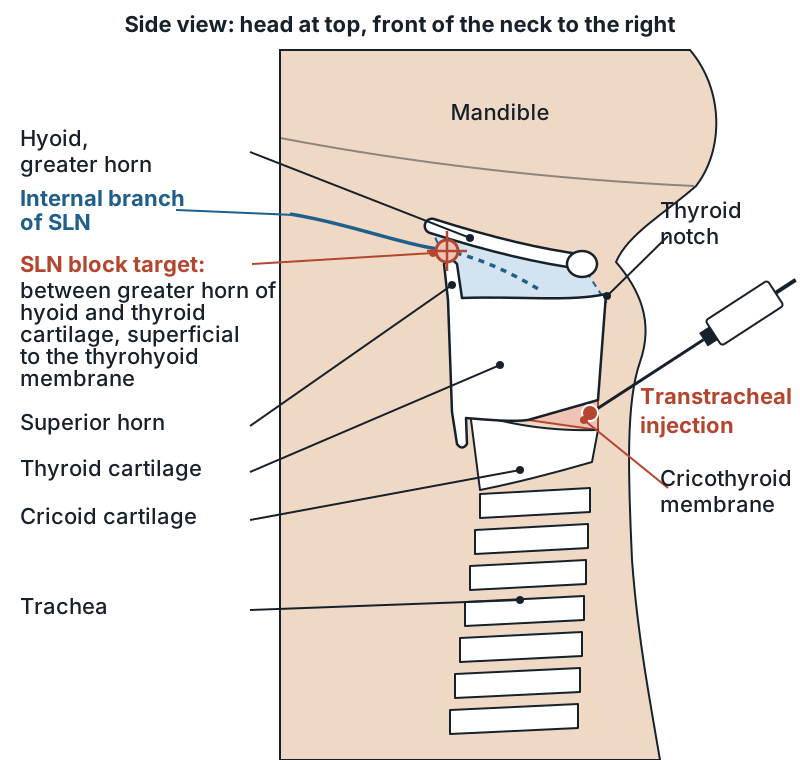
- Topicalization over nerve blocks — superior laryngeal and transtracheal blocks add needles and hematoma near a difficult airway; a dry, well-topicalized patient tolerates the scope without them. Changes if time is short and the neck accessible: transtracheal injection.
- Why dry first — it is optional, but without an antisialagogue the lidocaine washes off and the scope sees only secretions. Onset is 3–5 minutes IV, about 20 minutes IM.1
- Which sedative — dexmedetomidine preserves drive and airway tone, costing bradycardia and hypotension, so I load slowly. Remifentanil blunts cough but can cause apnea; either as a single agent is safest; propofol alone causes more over-sedation and obstruction.1 Midazolam alone: disinhibition, no analgesia.
- Nasal versus oral — nasal gives a straighter path and a scope he cannot bite, at the cost of epistaxis, so I use lidocaine with phenylephrine rather than cocaine1 and avoid it in coagulopathy or base-of-skull fracture.
- Tube — reinforced or Parker-tip, half a size smaller; if it catches on the arytenoids, I withdraw slightly and rotate 90° counter-clockwise.
- Confirm before induction — carina through the tube and capnography, then breath sounds, then propofol.1 Inducing on an esophageal tube in a patient who cannot be mask ventilated is the worst outcome this topic produces.
Follow-up question
Halfway through, after you increase the remifentanil infusion, he stops responding and stops breathing, and the saturation drifts down through 90%. What do you do?
Follow-up answer
HeadlineOver-sedation on top of local anesthetic in the airway: he is apneic. I stop the sedative and the scope and call for help.
Jaw thrust on running high-flow nasal oxygen; two-handed mask if it fails. If I can ventilate, naloxone for the remifentanil, let him wake, then resume with less sedation or a new plan. If not, this is cannot-intubate, cannot-oxygenate: a supraglottic airway, then front-of-neck access. The other curveball: local anesthetic toxicity from a generous topical dose: perioral numbness, agitation, then seizure; a benzodiazepine and 20% lipid emulsion, a 100 mL bolus over 2–3 minutes because he is over 70 kg.4 I reassess breathing and neurology before going on.
Pitfalls that cost points
- Sedating to unresponsiveness and calling it awake.
- Forgetting that topical lidocaine counts toward the toxic total.
Rapid-fire
Q: Why does he still cough at the cords after a good oropharyngeal spray? A: Sensation below the cords is from the recurrent laryngeal nerve; I spray 2 mL of lidocaine through the scope onto the cords and into the trachea, or do a transtracheal injection.
Q: Why is aspiration risk higher during awake intubation? A: Topicalization abolishes the laryngeal reflexes that protect the trachea; a full-stomach patient needs the shortest possible time between topicalization and a cuffed tube.
Q: Why not ketamine as the sole sedative? A: It preserves drive but increases secretions and produces a patient who moves and may not cooperate; in small doses with dexmedetomidine it works well.
Q: What if the patient refuses? A: I explore why and explain the alternative risks my being unable to breathe for him; if he still refuses, an inhalational or careful intravenous induction with a surgeon scrubbed for a surgical airway, discussion documented.
Numbers to know
| Item | Value |
|---|---|
| Glycopyrrolate | 0.1–0.2 mg IV (onset 3–5 min) or 0.2–0.4 mg IM 30–60 min before1 |
| Topical lidocaine maximum | 9 mg/kg lean body weight total1 |
| Dexmedetomidine | 1 mcg/kg over 10 min, then 0.7 mcg/kg/h2 |
| Remifentanil | 0.05–0.1 mcg/kg/min, target spontaneous breathing |
| Tube size | 0.5–1.0 mm ID smaller than standard, reinforced |
| Lipid emulsion 20% for toxicity | 1.5 mL/kg, then 0.25 mL/kg/min (100 mL bolus if over 70 kg)4 |
Links
- Anticipated difficult airway and the ASA algorithm, Cannot intubate, cannot oxygenate, Airway management with cervical spine injury, Anterior mediastinal mass, Extubation of the difficult airway
- Atlas: Capnography: waveforms and sudden loss of ETCO2
- ASA Practice Guidelines for Management of the Difficult Airway (2022); Difficult Airway Society guidelines for awake tracheal intubation in adults
Sources
- 1.Difficult Airway Society guidelines for awake tracheal intubation (ATI) in adults · DAS, 2020 · ebi.ac.ukFull text via Europe PMC (PMC7078877); Table 3 drug doses.
- 2.PRECEDEX (dexmedetomidine) injection prescribing information · FDA / DailyMed · dailymed.nlm.nih.govAwake fiberoptic intubation: 1 mcg/kg over 10 min, then 0.7 mcg/kg/h until the tube is secured.
- 3.2022 American Society of Anesthesiologists Practice Guidelines for Management of the Difficult Airway · ASA, 2022 · asa2.silverchair.com
- 4.Checklist for Treatment of Local Anesthetic Systemic Toxicity (LAST) · ASRA Pain Medicine, 2020 · asra.com
Facts on this page were checked against these sources on Oct 14, 2026. Guidelines change; confirm doses against current institutional protocols.