Inherited arrhythmia syndromes: long QT, WPW and Brugada
Stem
A 26-year-old woman, 61 kg, with congenital long QT syndrome type 2, is scheduled for laparoscopic cholecystectomy. She had syncope at 19 and has a single-chamber ICD that has never fired. She takes nadolol. Her QTc today is 510 ms. Potassium is 3.4 mmol/L and magnesium 1.7 mg/dL, low-normal. She is anxious and asks whether anesthesia is safe for her heart.
Question
How will you anesthetize her?
Ideal answer
HeadlineHer danger is torsades, so I keep repolarization quiet: no QT-prolonging drugs, no adrenergic surges, normal electrolytes, and the treatment in the room.
- Nadolol this morning; potassium to ≥4, magnesium to ≥2 first, because hypokalemia and low magnesium invite torsades and correcting them is part of its treatment.1,2
- ICD tachy detection suspended, pads anterior/posterior, because upper-abdominal monopolar cautery can trigger a false shock; therapies back on before she leaves monitoring.3
- Calm, deep induction and smooth emergence: anxiolysis, propofol, opioid before laryngoscopy, because catecholamine surges trigger arrhythmia.4
- No ondansetron or droperidol; dexamethasone for nausea, sugammadex rather than neostigmine with an anticholinergic.4
- Magnesium drawn up and defibrillator ready.4
Watch for: lengthening QT, R-on-T ectopy and pause-dependent runs on a multi-lead ECG through recovery.
Breaking down the answer
- Know the thresholds — risk climbs above a QTc of 0.50 s; prolonged is over 0.45 s in men and 0.47 s in women.1 Changes if: acquired, I remove the culprit drug and recheck.
- The drug list — class Ia, Ic and III antiarrhythmics, tricyclics, phenothiazines and some antimicrobials prolong QT; I check CredibleMeds for the rest.1 Volatile agents add repolarization burden, so I keep them low.4
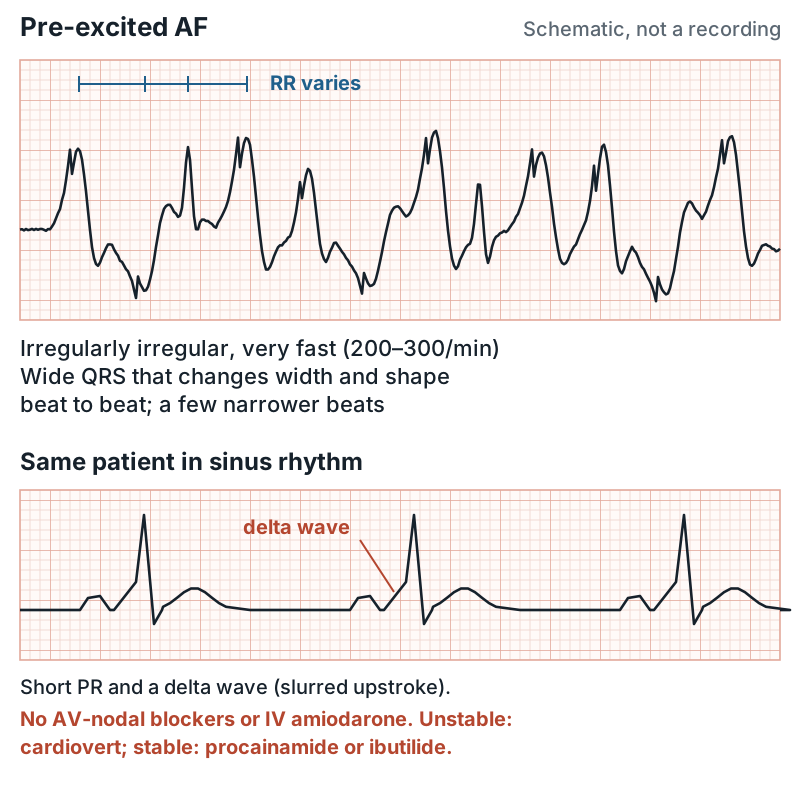
- WPW with atrial fibrillation — the accessory pathway bypasses the node, rates reach 200–300 and VF follows.5 Unstable: synchronized cardioversion. Stable: IV procainamide or ibutilide, or elective cardioversion.6 AV-nodal blockers (adenosine, beta-blockers, verapamil, diltiazem, digoxin) and IV amiodarone are harmful.6
- Brugada drugs — avoid sodium-channel blockers (flecainide, propafenone, procainamide, ajmaline), tricyclics, lithium and cocaine; bupivacaine, procaine and propofol carry conflicting class IIa evidence, prolonged propofol infusion the main concern.7
- Brugada in practice — 146 propofol anesthetics in 92 high-risk patients caused no arrhythmia outside VF ablation.8 Lidocaine is preferred over longer-acting local anesthetics.9
- Brugada triggers — vagal tone, beta-blockade and alpha-agonists worsen ST elevation; isoproterenol settles it.9 Fever gets prompt acetaminophen and ECG monitoring.10
Follow-up question
As the gallbladder is retrieved, a pause follows a run of ectopy and the monitor shows polymorphic ventricular tachycardia twisting around the baseline. The pleth trace disappears, end-tidal CO2 falls from 36 to 8 mmHg, and her blood pressure is unrecordable.
What do you do?
Follow-up answer
HeadlineTorsades with no output; I call for help and defibrillate, because her ICD is off.
Unsynchronized shock, 120–200 J biphasic, and CPR.1 Magnesium sulfate 2 g IV over 1–2 minutes, repeated in 5–10 minutes, then 3–20 mg per minute.1 Early recurrence is common,1 so I correct potassium and raise her rate by pacing, which shortens the QT;1 not isoproterenol, since her syndrome is adrenergically triggered. Once stable I restore ICD therapies, recheck electrolytes and the drug list, and monitor her in a unit.
Pitfalls that cost points
- Treating pre-excited atrial fibrillation with a beta-blocker or calcium-channel blocker because it "looks like" fast AF.
- Antiemetic prophylaxis by habit: ondansetron in a QTc of 510 ms.
Rapid-fire
Q: How do you recognize pre-excited AF on the monitor? A: Very fast, irregular, wide and varying QRS complexes; a short PR and delta wave in sinus rhythm.5
Q: What is the definitive treatment for WPW? A: Catheter ablation of the accessory pathway, arranged before elective surgery where possible.6
Q: How does Brugada differ from long QT at the bedside? A: Beta-blockade and alpha stimulation worsen Brugada ST changes, and a beta-agonist settles them; long QT needs its beta-blocker continued.9
Q: Why lidocaine for torsades? A: As a class Ib agent it may shorten the QT, especially when a drug caused the torsades.1
Numbers to know
| Item | Value |
|---|---|
| Normal QTc | <0.43 s men, <0.45 s women1 |
| High torsades risk | QTc >0.50 s1 |
| Magnesium | 2 g over 1–2 min, repeat in 5–10 min; 3–20 mg/min1 |
| Defibrillation | 120–200 J biphasic1 |
| Pre-excited AF rate | Up to 200–300/min5 |
| Electrolyte targets | K ≥4 mmol/L, Mg ≥2 mg/dL2 |
Links
- Pacemakers and ICDs in the operating room, Atrial fibrillation: new onset and chronic, ACLS adapted to the operating room, Monitor atlas: perioperative cardiac events, ponv
- Atlas: Monitor atlas: perioperative cardiac events
- CredibleMeds QTdrugs list; BrugadaDrugs.org; 2023 ACC/AHA/ACCP/HRS AF guideline; HRS/ASA CIED consensus statement (2011)
Sources
- 1.Torsades de Pointes Ventricular Tachycardia · Merck Manual Professional Edition · merckmanuals.com
- 2.Position Statement on the Diagnosis and Treatment of Electrical Storm - 2026 · Brazilian Society of Cardiology (Soeiro et al., Arq Bras Cardiol), 2026 · europepmc.orgPolymorphic VT and acquired long QT table: potassium replaced to keep serum potassium above 4 mEq/L; magnesium kept above 2 mg/dL reduces ventricular ectopy and recurrence.
- 3.HRS/ASA Expert Consensus Statement on the Perioperative Management of Patients with Implantable Defibrillators, Pacemakers and Arrhythmia Monitors: Executive Summary · Heart Rhythm Society / American Society of Anesthesiologists, 2011 · anesth.utmb.eduCrossley et al., Heart Rhythm 2011. Table 5 algorithm: suspend ICD tachyarrhythmia detection, pads anterior/posterior, evaluate before leaving a monitored setting.
- 4.Perioperative anesthetic management and procedural sedation in a child with type 1 congenital long QT syndrome undergoing serial procedures: a case report · BMC Anesthesiology (Tu et al.), 2026 · ebi.ac.uk
- 5.Atrial Fibrillation and Wolff-Parkinson-White Syndrome (WPW Syndrome) · Merck Manual Professional Edition · merckmanuals.com
- 6.2023 ACC/AHA/ACCP/HRS Guideline for the Diagnosis and Management of Atrial Fibrillation · ACC/AHA/ACCP/HRS, 2023 · pmc.ncbi.nlm.nih.govCirculation 2024;149:e1-e156. Section 10.6, WPW and preexcitation syndromes; full text read via the PMC OAI service.
- 7.Drugs to be avoided by Brugada syndrome patients · BrugadaDrugs.org Advisory Board · brugadadrugs.org
- 8.Safety of propofol use for general anaesthesia in Brugada syndrome patients: a 15-year experience · Europace (Tixier et al.), 2025 · ebi.ac.uk
- 9.Anesthesiological management of Brugada syndrome patients: A systematic review · Saudi Journal of Anaesthesia (Cuttone et al.), 2023 · ebi.ac.uk
- 10.Patient letter: drugs in Brugada syndrome · BrugadaDrugs.org · brugadadrugs.org
Facts on this page were checked against these sources on Oct 22, 2026. Guidelines change; confirm doses against current institutional protocols.