Complex regional pain syndrome
Stem
A 47-year-old woman, 70 kg, developed complex regional pain syndrome of the left hand after a distal radius fracture 14 months ago. She now needs removal of a prominent volar plate and a carpal tunnel release on the same wrist. Her hand is swollen, cooler and mottled compared with the right, with allodynia to light touch. Pain is 7 out of 10 on pregabalin 150 mg twice daily and duloxetine 60 mg daily. She is afraid surgery will make it worse.
Question
How will you anesthetize her, and can you lower her risk of a flare?
Ideal answer
HeadlineA catheter block, a pain plan started before incision and early therapy; I tell her honestly that flare risk is real and no technique is proven to prevent it.
- Document Budapest findings and her baseline, so any later change is attributable.1
- Continue pregabalin and duloxetine, because stopping them provokes rebound pain and withdrawal.
- Infraclavicular catheter, needle away from the allodynic skin. Two to three days of dense analgesia lets her hand therapy start; no technique has proven to prevent recurrence.2
- Low-dose ketamine through surgery as anti-hyperalgesic analgesia; the infusion evidence in CRPS is a separate question.3
- Short tourniquet time, then movement on day one with her hand therapist, because function-based therapy is the core treatment.1
Watch for: swelling, color change or allodynia spreading beyond the incision over the next weeks.
Breaking down the answer
- Budapest criteria — disproportionate pain; symptoms in three of four categories and examined signs in two of four (sensory, vasomotor, sudomotor or edema, motor or trophic); no better diagnosis. Sensitivity 0.85–0.99, specificity 0.68–0.69, versus 0.98 and 0.36 (1994).1
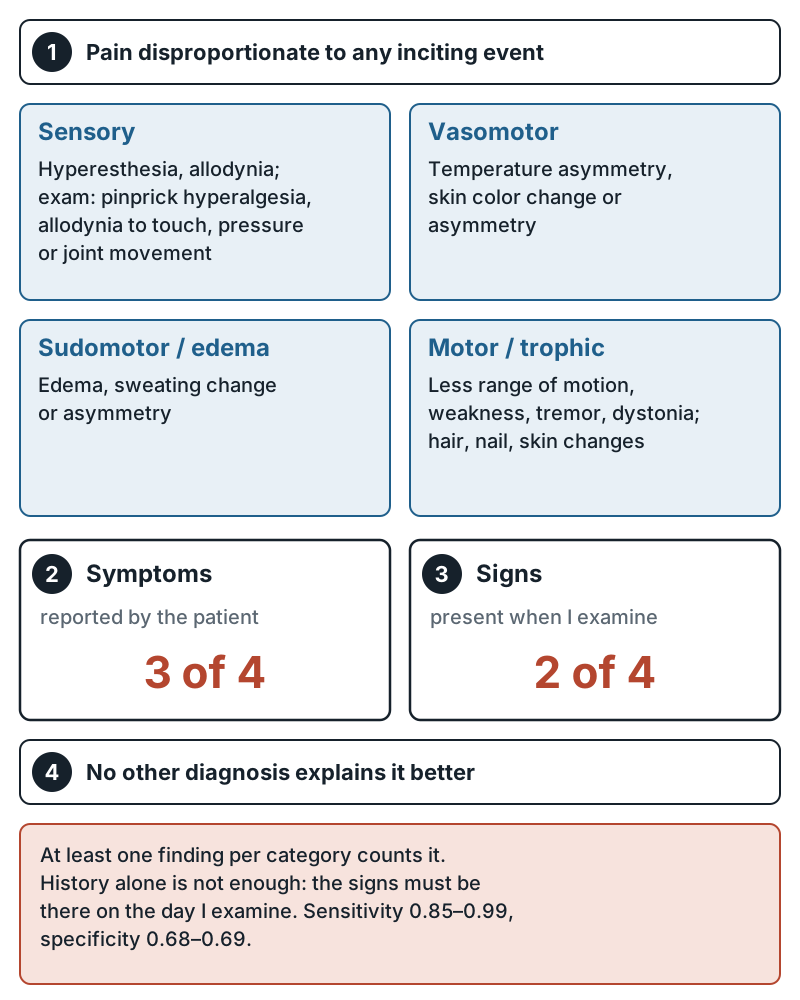
- The honest regional answer — in 301 carpal tunnel releases, CRPS occurred in 8.3% regardless of general anesthesia, IV regional with or without clonidine, or axillary block.2 Regional earns its place through analgesia and earlier therapy.
- Ketamine dosing — the consensus cites 22 mg/h for 4 days, or 0.35 mg/kg/h over 4 hours daily for 10 days, with relief up to 12 weeks; hepatotoxicity appeared on re-exposure.3
- Vitamin C, stated plainly — evidence conflicts: Ekrol's 2014 trial and a meta-analysis of three trials showed no significant prevention.4 A 134-patient trial of 500 mg daily found no better function or pain.5 It is cheap and benign; I don't promise it.
- Neuromodulation — stimulation plus therapy cut pain 2.4 cm versus a 0.2 cm rise at 6 months, without functional gain; 6 of 24 implants needed reoperation.6 Dorsal root ganglion stimulation beat it in lower-limb CRPS at 3 and 12 months.7
- Sympathetic blocks — used mainly for failure to progress, as a window to restart therapy.1
Follow-up question
Three weeks after an uneventful operation she returns. The whole hand and forearm are swollen, dusky and exquisitely allodynic, she cannot tolerate her splint or therapy, and she asks whether an amputation would end it. What do you do?
Follow-up answer
HeadlineThis is a CRPS flare spreading beyond the field; I tell her it is treatable and get her moving again now.
First I exclude infection, hematoma, compartment syndrome and thrombosis. Therapy is the core again; pain that blocks it earns a stellate ganglion block series.1 Early inflammatory CRPS justifies a short oral steroid course,4 and a bisphosphonate: four 100 mg neridronate infusions beat placebo in an 82-patient trial.8 I optimize neuropathic agents, consider ketamine infusions,3 and refer her to an interdisciplinary program; a stimulator trial follows if refractory.6 Amputation does not reliably end CRPS pain, and CRPS recurs in about half, so I do not recommend it.9 I review her weekly.
Pitfalls that cost points
- Diagnosing CRPS from her history alone: the Budapest signs must be present when you examine her.1
- Leaning on Scott Reuben's perioperative CRPS studies: his fabricated work led to mass retractions, so check any cited trial's authorship.10
Rapid-fire
Q: What separates CRPS type 1 from type 2? A: Type 2 follows a confirmed nerve injury; type 1 has none.
Q: Which patients are at higher risk after a wrist fracture? A: Early pain of 5 out of 10 or more, swelling, slow reaction time and depression predict it.4
Q: Who should not receive ketamine infusions? A: Patients with poorly controlled cardiovascular disease or psychosis; avoid in severe liver disease and serial infusions with active substance abuse.3
Q: How common is CRPS after carpal tunnel release? A: 8.3% in one series of 301 patients.2
Numbers to know
| Item | Value |
|---|---|
| Budapest symptoms / signs | 3 of 4 / 2 of 4 categories1 |
| Budapest sensitivity / specificity | 0.85–0.99 / 0.68–0.691 |
| CRPS after carpal tunnel release | 8.3%2 |
| Ketamine CRPS regimen | 0.35 mg/kg/h, 4 h daily for 10 days3 |
| SCS pain reduction (Kemler) | 2.4 cm at 6 months6 |
| DRG vs SCS success | 81.2% vs 55.7% (3 mo); 74.2% vs 53.0% (12 mo)7 |
Links
- Supraclavicular, infraclavicular and axillary blocks, Intravenous regional anesthesia, Dexmedetomidine and ketamine, Regional anesthesia in the anticoagulated patient with pre-existing neuropathy, The patient with a spinal cord stimulator or intrathecal pump
- CRPS Practical Diagnostic and Treatment Guidelines, 5th edition (2022); ASRA/AAPM/ASA ketamine consensus for chronic pain (2018)
Sources
- 1.Complex Regional Pain Syndrome: Practical Diagnostic and Treatment Guidelines, 5th Edition · Pain Medicine, 2022 · pmc.ncbi.nlm.nih.govHarden RN, et al. Pain Med 2022;23(Suppl 1):S1-S53. Budapest criteria, Table 2.
- 2.Incidence of regional pain syndrome after carpal tunnel release. Is there a correlation with the anesthetic technique? · Revista Brasileira de Anestesiologia, 2011 · scielo.br301 patients; 8.3% CRPS; no association with general, IVRA, IVRA with clonidine or axillary block.
- 3.Consensus Guidelines on the Use of Intravenous Ketamine Infusions for Chronic Pain · ASRA / AAPM / ASA, 2018 · pmc.ncbi.nlm.nih.govCohen SP, et al. Reg Anesth Pain Med 2018;43:521-46.
- 4.Complex regional pain syndrome after distal radius fracture: A survey of current practices · PLoS One, 2024 · pmc.ncbi.nlm.nih.govWang AT, et al. PLoS One 2024;19(11):e0314307. Reviews conflicting vitamin C evidence (Ekrol 2014 RCT; Evaniew meta-analysis of 3 RCTs).
- 5.Vitamin C does not aid recovery after distal radius fracture · Massachusetts General Hospital Advances, 2020 · advances.massgeneral.orgSummary of Chen N, et al. Clin Orthop Relat Res 2019: 134-patient RCT of vitamin C 500 mg daily; outcome motion, function and pain, not CRPS incidence.
- 6.Spinal cord stimulation in patients with chronic reflex sympathetic dystrophy (abstract) · Orthobullets evidence (N Engl J Med abstract), 2000 · orthobullets.comKemler MA, et al. N Engl J Med 2000;343:618-24.
- 7.Dorsal root ganglion stimulation yielded higher treatment success rate for complex regional pain syndrome and causalgia at 3 and 12 months: a randomized comparative trial · Pain, 2017 · pmc.ncbi.nlm.nih.govDeer TR, et al. Pain 2017;158:669-81 (ACCURATE; 152 randomized).
- 8.Treatment of complex regional pain syndrome type I with neridronate: a randomized, double-blind, placebo-controlled study · Rheumatology (Oxford), 2013 · bibgraph.hpcr.jpVarenna M, et al. Rheumatology 2013 (PMID 23204550); 82 patients, 100 mg IV four times over 10 days.
- 9.Amputation for complex regional pain syndrome: A systematic review · The Journal of Pain (Gilanyi, Ferraro, Goebel, O'Connell et al.), 2025 · europepmc.org67 studies, 249 patients: no clear evidence that amputation gives more pain relief than no amputation; phantom pain 67%, residual limb pain 66%, CRPS recurrence 47%. Abstract read.
- 10.A scoping review of retracted publications in anesthesiology · Saudi Journal of Anaesthesia (Fiore et al.), 2021 · europepmc.orgFujii, Boldt and Reuben account for about four-fifths of anesthesiology retractions; in 2009 Anesthesia & Analgesia retracted 10 Reuben articles for fabricated data. Reuben's CRPS fasciectomy study (Anesth Analg 2006) is indexed as retracted.
Facts on this page were checked against these sources on Oct 22, 2026. Guidelines change; confirm doses against current institutional protocols.