Cancer pain, opioid rotation and neurolytic blocks
Stem
A 63-year-old man, 68 kg, with unresectable pancreatic adenocarcinoma has constant epigastric pain boring through to his back. He takes extended-release morphine 120 mg twice daily and immediate-release morphine 30 mg about six times a day, yet rates his pain 8 out of 10. He is drowsy, constipated and has myoclonic jerks. Creatinine is 1.9 mg/dL. He is booked for an endoscopic biliary stent tomorrow, and oncology asks for your help.
Question
How would you improve his pain control?
Ideal answer
HeadlineThis is opioid toxicity on top of visceral pain that opioids are failing to control: I rotate off morphine and offer celiac plexus neurolysis now, not as a last resort.
- Rotate off morphine, calculated dose cut by half. 420 mg oral morphine a day to fentanyl, whose metabolites are inactive in failing kidneys,1 less 50% for incomplete cross-tolerance.2
- Breakthrough at 10% of the daily dose, reassessed daily.2
- Celiac neurolysis by endoscopic ultrasound during tomorrow's endoscopy. It lowers opioid use and side effects, though the pain-score gain is small.3,4
- Adjuvants, with the WHO ladder as a guide. Dexamethasone is strongly supported; the ladder teaches but does not replace individual planning.5
- Intrathecal pump if blocks fail and he has months. It improved pain and halved opioid toxicity in a randomized trial.6
Watch for: sedation after rotation; hypotension, diarrhea after the block.
Breaking down the answer
- Rotation, not escalation — more morphine with myoclonus and sedation feeds the toxicity; a new opioid often works at a lower equianalgesic dose. Changes if: I choose methadone, whose high chronic doses prolong QT, so I get an ECG.7
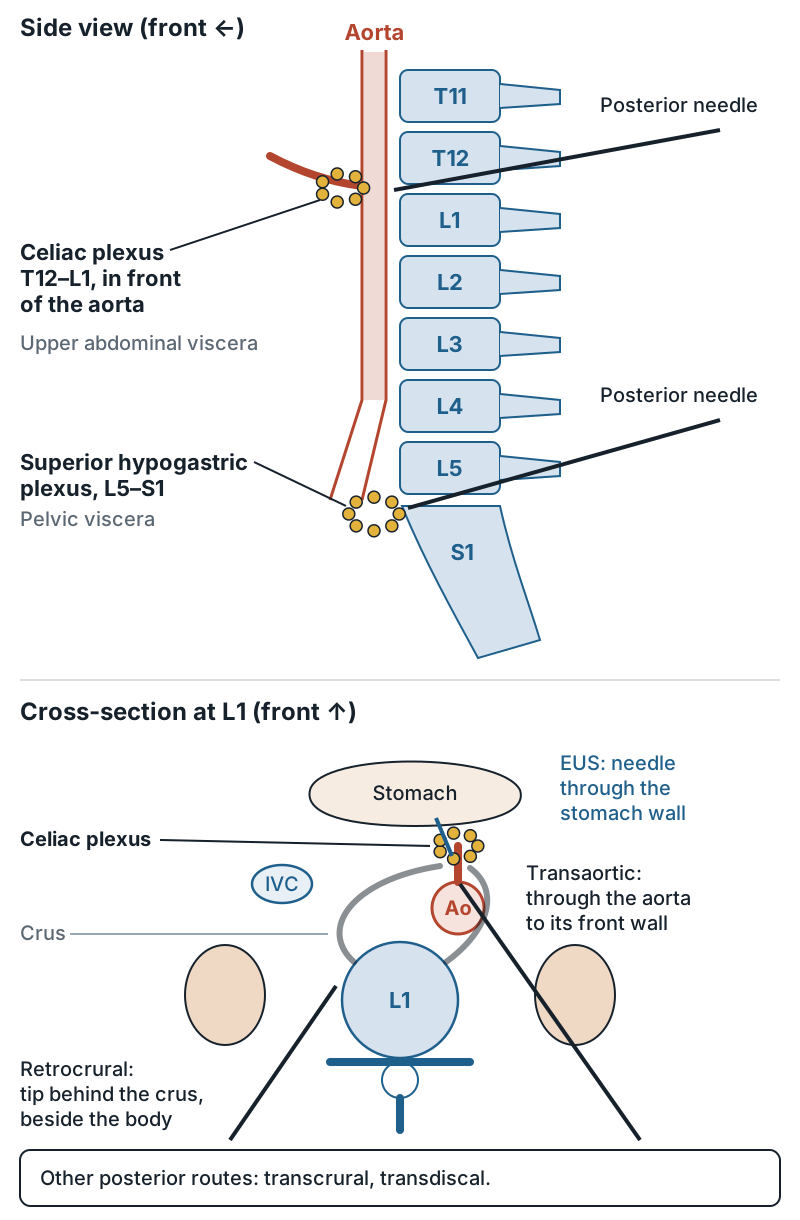
- Which plexus — celiac for upper abdominal viscera, at T12–L1 anterior to the aorta and crura;8 superior hypogastric at L5–S1 for pelvic viscera, with about 70% pain reduction in early series.9 Neither treats somatic or neuropathic pain.
- Early, not last — the Cochrane review (6 trials, 358 patients) found a small pain benefit but significantly less opioid and fewer opioid side effects.3 Tumor spread beyond the plexus lowers success, so judgment means offering it early.
- Approach — posterior fluoroscopic or CT routes (retrocrural, transcrural, transaortic, transdiscal) or endoscopic ultrasound from the stomach; lower injectate volume and less sedation are linked to better neurolysis.10
- Intrathecal therapy — Smith's trial of 200 patients: clinical success 84.5% versus 70.8%, opioid toxicity improved in 50% versus 17%.6 Changes if: life expectancy is weeks, coagulopathy or infection; then an externalized catheter.
- Agent — alcohol 50–100% burns on injection, so local anesthetic goes first;11 endoscopic series use 10–20 mL of 98% alcohol.4 Phenol (6.7% aqueous, stronger in glycerol) has an immediate local anesthetic effect but a shorter, less profound block.11
- Bone pain — radiotherapy is strongly recommended, and a single fraction shortens waiting and cost.5
Follow-up question
Two hours after a posterior alcohol neurolysis his blood pressure falls to 76/40 when he sits up, and an hour later he cannot move his legs. What is happening and what do you do?
Follow-up answer
HeadlineThe hypotension is expected sympathectomy; the leg weakness is spinal cord injury until proven otherwise, and I treat it as an emergency.
He lies flat with fluid and a vasopressor, since orthostatic hypotension is the commonest complication;8 I check hemoglobin and get CT to exclude retroperitoneal hemorrhage. Paraplegia is recognized:8,10 spasm or injury of the artery of Adamkiewicz causes an anterior spinal artery syndrome, or injectate spreads to the neuraxis. I examine the level and keep his pressure up; local anesthetic weakness recedes, alcohol injury does not. Urgent MRI to exclude hematoma, neurology and neurosurgery, disclosure to him and his family, and hourly neurologic checks.
Pitfalls that cost points
- Calling a rising requirement tolerance when myoclonus and sedation are telling you it is neurotoxicity.
- Titrating a fentanyl patch for uncontrolled pain: it takes many hours to reach effect, so crises need immediate-release doses.
Rapid-fire
Q: Why does diarrhea follow celiac neurolysis? A: Sympathetic denervation of the gut leaves parasympathetic activity unopposed.8
Q: Which agent is preferred for neurolytic celiac block? A: Alcohol; local anesthetic and steroid are used for benign pain.8
Q: How do you convert him to a fentanyl patch? A: Daily oral morphine equivalent divided by 2 gives the patch dose in mcg/h, so 420 mg/day is about 200 mcg/h before the rotation reduction.2
Q: How do you anesthetize a patient on 420 mg/day of oral morphine for surgery? A: Continue the baseline as oral or IV equivalent, add ketamine and regional techniques, and titrate opioid to respiratory rate; expect large doses.
Q: Where does the WHO now place the analgesic ladder? A: As a teaching tool and general guide that cannot replace individual planning.5
Numbers to know
| Item | Value |
|---|---|
| His oral morphine equivalent | 420 mg/day |
| Rotation dose reduction | 50% of calculated dose2 |
| Breakthrough dose | 10% of daily oral morphine equivalent2 |
| Celiac plexus level | T12–L18 |
| Celiac block pain benefit | VAS −0.42 at 4 weeks3 |
| Superior hypogastric neurolysis | ~70% pain reduction9 |
| Intrathecal pump trial | Toxicity better in 50% vs 17%6 |
Links
- Acute pain in the opioid-tolerant patient, The patient with a spinal cord stimulator or intrathecal pump, PCA and multimodal analgesia, Chronic kidney disease and the dialysis patient, Dexmedetomidine and ketamine
- WHO guidelines for cancer pain in adults and adolescents (2018); Cochrane review of celiac plexus block (2011)
Sources
- 1.Opioids to Treat Chronic Pain in the Older Adult: A Clinical Consensus to Guarantee Safety and Avoid Adverse Events · Drugs & Aging (Ribeiro et al., clinical consensus), 2026 · europepmc.orgFentanyl (inactive metabolites) and buprenorphine are the more appropriate options in chronic kidney disease; morphine, codeine and tramadol accumulate and should generally be avoided.
- 2.Opioid Equivalency · StatPearls (NCBI Bookshelf), 2022 · ncbi.nlm.nih.gov
- 3.Celiac plexus block for pancreatic cancer pain in adults · Cochrane, 2011 · cochrane.orgArcidiacono PG, et al. Cochrane Database Syst Rev 2011;CD007519. 6 RCTs, 358 participants.
- 4.Celiac plexus neurolysis in pancreatic cancer: the endoscopic ultrasound approach · World Journal of Gastroenterology, 2014 · wjgnet.comSeicean A. World J Gastroenterol 2014;20(1):110-17.
- 5.Updated guidelines provide vital insights for pain management of cancer patients (WHO 2018 cancer pain guidelines) · IASLC Lung Cancer News · ilcn.orgSummary of WHO Guidelines for the pharmacological and radiotherapeutic management of cancer pain in adults and adolescents (2018, published 2019).
- 6.IDDS reduces pain and toxicity in cancer pain patients · CancerNetwork · cancernetwork.comSmith TJ, et al. J Clin Oncol 2002;20:4040-49; 200 patients randomized.
- 7.Use of Methadone in the Perioperative Period · APSF · apsf.org
- 8.Celiac Plexus Block · StatPearls (NCBI Bookshelf), 2024 · ncbi.nlm.nih.gov
- 9.The Role of Double Modality Ultrasonographic and Fluoroscopic Guided Superior Hypogastric Plexus Neurolysis in Treating Intractable Pelvic Cancer Pain · Journal of Pain Research, 2021 · dovepress.comAbdelghafar EM, et al. J Pain Res 2021;14:1465-73; discussion cites Plancarte's ~70% pain reduction.
- 10.Pros and Cons: The Transdiscal Approach to Celiac Plexus Block With or Without Neurolysis · ASRA Pain Medicine News, 2025 · asra.comCraven JM, Cohen SP.
- 11.Neurolytic techniques for pain management · Coccyx.org reprint (Rowe DS) · coccyx.orgSecondary reprint of a review on neurolytic agents; alcohol 50-100%, phenol maximum 6.7% aqueous.
Facts on this page were checked against these sources on Oct 22, 2026. Guidelines change; confirm doses against current institutional protocols.