Patient safety after a serious event: RCA, FMEA and just culture
Stem
A 67-year-old woman, 80 kg, is scheduled for a left total knee arthroplasty under spinal anesthesia. In the busy preoperative area, a right adductor canal block with 20 mL of 0.5% ropivacaine was performed by a resident you supervise. The nurse was covering two bays, the patient had been turned for a line, and the surgical site mark was under the blanket. The error was caught at the surgical time-out. She is comfortable, with a numb right medial leg.
Question
What do you do now, and how will your department make sure this does not happen again?
Ideal answer
HeadlineA wrong-site block is a sentinel event even without lasting harm. I make her safe, disclose honestly, report it, and drive a systems analysis.
- Patient first. A left-sided block only if the total ropivacaine dose stays safe, LAST vigilance, fall precautions for the numb leg; the surgeon and I decide whether to proceed.
- Disclose today, with an apology. What happened, what it means for her, and what we will do.
- Report and analyze. A same-day safety report; the comprehensive systematic analysis and action plan are due within 45 business days.1
- RCA2 within 72 hours. Four to six people not involved, asking why until systems causes appear, never assigning blame.2
- Stronger actions, measured. At least one stronger or intermediate action, with an owner, a date and a measure.2
Breaking down the answer
- It is not rare — 0.52 to 5.07 per 10,000 blocks, and nearly 26% of wrong-site procedures reported in Pennsylvania since 2004; distraction and hidden marks recur.3 Changes if: it reached no patient; it is a close call, still analyzed.
- Just culture — error, at-risk and reckless behavior are judged by behavior, not outcome.4 Knowingly skipping a time-out is reckless; a ritualized time-out is at-risk behavior, and is coached. Changes if: impairment or a deliberately unsafe act; separate review, outside RCA2.2
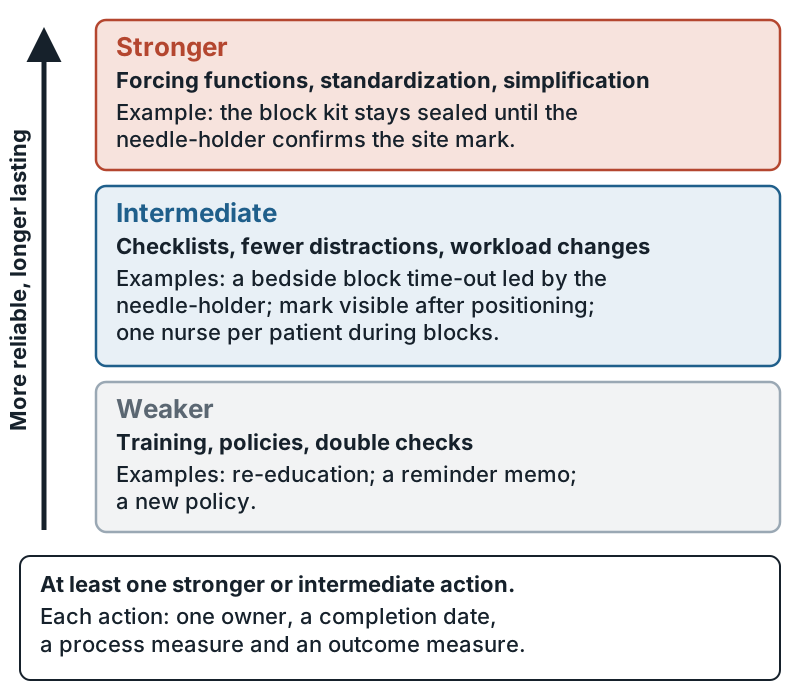
- The action hierarchy — stronger: forcing functions, standardization, simplification; intermediate: checklists, fewer distractions, workload changes; weaker: training, policies, double checks.2 Changes if: only weak actions are proposed; the RCA is incomplete.
- FMEA looks forward — map the process, score each failure mode 1 to 10 for severity, occurrence and detectability, multiply to a risk priority number, fix the highest first.5 Changes if: harm has occurred; that calls for an RCA instead.
- Checklists help when used — the WHO 19-item checklist cut deaths from 1.5% to 0.8% and complications from 11.0% to 7.0%.6 Changes if: the time-out is recited, not performed; it protects nobody.
Follow-up question
Three weeks later the RCA team proposes re-educating the block nurses and sending a department memo about site marking. Is that enough?
Follow-up answer
HeadlineNo. Education and memos are weak actions that fade; I push for stronger ones.
Intermediate actions: a bedside block time-out led by the needle-holder, mark visible after positioning, and one nurse per patient during blocks. A stronger action: a forcing function, the block kit stays sealed until the needle-holder confirms the site mark. Each action gets one owner, a completion date, a process measure such as audited time-out compliance, and an outcome measure, wrong-site blocks per 10,000.2 Findings go back to staff and to the patient.
Pitfalls that cost points
- Calling it a near miss: the needle reached the patient.
- Naming the resident or nurse in the conference; the subject is the process.
- Confusing voluntary reporting to the Joint Commission with optional analysis.7
Rapid-fire
Q: What is a sentinel event? A: A patient safety event reaching the patient and causing death, permanent harm or severe harm; wrong-site procedures qualify regardless of outcome.1
Q: Who stays off the RCA team? A: Staff involved in the event and the patient or family; they are interviewed instead.2
Q: How long should the RCA take? A: Begin within 72 hours; finish in 30 to 45 days.2
Q: Who must take part in the final time-out? A: The person doing the procedure, the anesthesia providers, the circulating nurse and the technician, immediately before incision.8
Q: How do I show a fix worked? A: A run chart of the measure over time, using plan-do-study-act cycles.
Numbers to know
| Item | Value |
|---|---|
| Wrong-site block incidence | 0.52–5.07 per 10,0003 |
| Analysis and action plan due | 45 business days1 |
| RCA2 start; completion | 72 h; 30–45 days2 |
| RCA2 team | 4–6 people2 |
| FMEA scores | Severity × occurrence × detectability, each 1–105 |
| WHO checklist deaths | 1.5% to 0.8%6 |
Links
- Practice-based learning and QI projects, Disclosing a peri-procedural complication or error, Local anesthetic systemic toxicity, Femoral, adductor canal and popliteal blocks
- NPSF RCA2 (2015); Joint Commission Sentinel Event Policy and Universal Protocol
Sources
- 1.Sentinel Event Policy (SE chapter), Update 1, July 2026 · The Joint Commission, 2026 · digitalassets.jointcommission.orgHome Care manual chapter. The hospital (CAMH) chapter could not be retrieved; the Telehealth and Nursing Care Center chapters (July 2026) give identical wording for the definition, wrong-site events regardless of outcome, and the 45-business-day deadline.
- 2.RCA2: Improving Root Cause Analyses and Actions to Prevent Harm · National Patient Safety Foundation (hosted by IHI), 2015 · stg.ihi.org
- 3.Peer-Driven Principles Promote Correct-Site Nerve Blocks · ASRA Pain Medicine News, 2018 · asra.com
- 4.Culture of Safety (PSNet primer) · AHRQ Patient Safety Network, 2024 · psnet.ahrq.gov
- 5.Performance improvement through proactive risk assessment: Using failure modes and effects analysis · Journal of Education and Health Promotion, 2014 · ebi.ac.ukAbstract via Europe PMC (PMID 25013821); method description.
- 6.A surgical safety checklist to reduce morbidity and mortality in a global population · New England Journal of Medicine (Haynes et al.), 2009 · ebi.ac.ukAbstract via Europe PMC (PMID 19144931).
- 7.Sentinel Event Policy and Procedures · The Joint Commission · jointcommission.orgProgram index page, which lists the Hospital program; states that reporting to the Joint Commission is strongly encouraged but not required.
- 8.Universal Protocol FAQ (National Patient Safety Goals) · The Joint Commission · jointcommission.org
Facts on this page were checked against these sources on Oct 22, 2026. Guidelines change; confirm doses against current institutional protocols.