Monitor atlas: ventilator modes and loops
Stem
Monitors station, scenario 3 of 3. The card reads: a 71-year-old man, 70 kg, with severe COPD, under general anesthesia for an open colectomy on volume control, tidal volume 500 mL, rate 18. The monitor shows:
Question
What do these waveforms show, and what will you do?
Ideal answer
What the monitor showed: volume control with a square inspiratory flow; expiratory flow still below zero when each next breath starts; peak pressure rising from 22 to 30 cmH2O; arterial pressure falling from 122/70 to 78/44.
HeadlineAuto-PEEP: expiratory flow never returns to zero, so he has not finished exhaling, and the trapped gas is dropping his pressure.1 I disconnect briefly to let him exhale.
- Mode, fixed curve, then pressure, flow, volume, trend. Volume control fixes the square inspiratory flow and the volume, so the pressure curve tells me about the patient.2
- Explain the hypotension. Trapped gas raises intrathoracic pressure and cuts venous return;1 COPD at a rate of 18 fits. After disconnection I watch the pressure come back.
- Lengthen expiratory time, chiefly by lowering the rate. That buys far more time than raising inspiratory flow.1
- Bronchodilator and suction. They treat the resistance behind it.
- End-expiratory hold to confirm and measure. Then expiratory flow should reach zero and the peak pressure settle.
Breaking down the answer
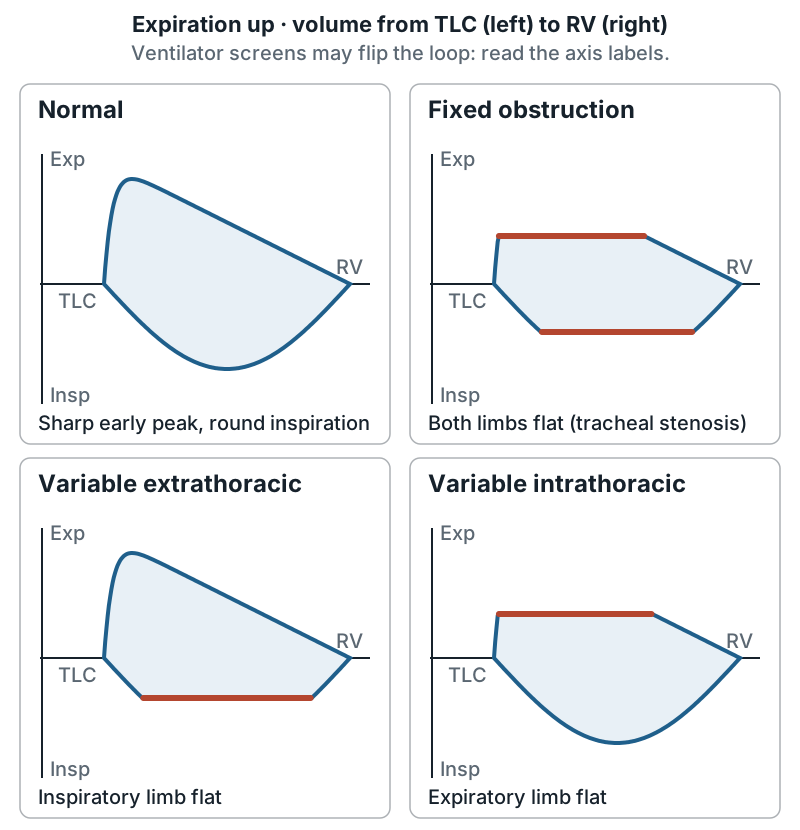
The outline lists airway pressure with peak and PEEP, flow, tidal volume, rate with inspiratory and expiratory times, and flow-volume loops, and asks for modes used in normal and critically ill patients.3
| Mode or pattern | Fixed by the clinician | What varies and what it means |
|---|---|---|
| Volume control, square flow | Flow and volume2 | Pressure; peak rises with resistance or stiffness |
| Pressure control | Pressure, a rectangle on the pressure curve2 | Flow decelerates; volume falls if the lungs stiffen or the tube narrows |
| Volume-targeted pressure control | Target volume, PEEP | Ventilator adjusts the pressure breath to breath to hit the volume2 |
| Pressure support | Support pressure, PEEP | Patient sets rate and timing; apnea gives no breaths |
| Auto-PEEP | Any mode | Expiratory flow not back to zero; measure with an end-expiratory hold1 |
| Fixed upper airway obstruction | Flow-volume loop | Both limbs flattened |
| Variable extrathoracic obstruction | Flow-volume loop | Inspiratory limb flattened |
| Variable intrathoracic obstruction | Flow-volume loop | Expiratory limb flattened |
- Peak versus plateau — the plateau pressure is measured during an inspiratory pause, when flow is zero, so the resistance component drops out.2 A high peak with a normal plateau means resistance: kinked tube, secretions, bronchospasm. Both high means compliance: endobronchial tube, pneumothorax, abdominal pressure, edema.
- Mode tells you which curve to read — in pressure control the tidal volume and flow curves carry the diagnosis. A candidate who reads the wrong curve misses the event.
- Lung protection — for ARDS, tidal volume 4–8 mL/kg predicted body weight and plateau below 30 cmH2O, starting at 6 mL/kg.4 For this 70 kg man I check his height-based weight, not his actual weight.
- Lowering tidal volume alone can backfire — in a breathing patient it can raise his own rate and shorten exhalation.1
Follow-up question
After the rate is lowered, the expiratory flow reaches zero and the pressure recovers. Ten minutes later the monitor shows:
What has happened, and what do you do?
Follow-up answer
What the monitor showed: peak pressure jumped from 24 to 42 cmH2O with the plateau steady at 18, and the capnogram changed to a sloped upstroke; expiratory flow still reached zero and the pressure held.
HeadlinePeak up, plateau unchanged: resistance, not a stiff lung.2 With COPD and a sloped capnogram, bronchospasm leads; I rule out the tube first.
I tell the room: 100% oxygen and hand-ventilation to feel the bag, a suction catheter to exclude a kink, secretions or a bitten tube, and I listen for wheeze. If the tube is clear, I deepen the volatile, give inhaled albuterol, and add epinephrine if the pressure falls. I keep the rate low because bronchospasm will bring the auto-PEEP straight back. Then the peak-plateau gap, the capnogram slope and the expiratory flow curve again.
Pitfalls that cost points
- Treating hypotension with fluid and pressors while auto-PEEP goes unrecognized.
- Raising the rate to clear CO2 in obstructive disease.
Rapid-fire
Q: How do you measure auto-PEEP? A: An end-expiratory pause closes the expiratory valve, flow stops, and the displayed pressure is total PEEP; total minus set PEEP is auto-PEEP.1
Q: What are the four harms of auto-PEEP? A: Hypotension, ventilator-induced lung injury, patient-ventilator asynchrony and increased dead space.1
Q: Which loop shows a fixed tracheal stenosis? A: A flow-volume loop with both the inspiratory and expiratory limbs flattened.
Q: In pressure control, the tidal volume falls with no change in settings: why? A: Compliance fell or resistance rose, so the same pressure delivers less volume.
Q: What is the area under the inspiratory flow curve? A: The tidal volume.2
Numbers to know
| Item | Value |
|---|---|
| ARDS tidal volume | 4–8 mL/kg PBW, start at 64 |
| Plateau pressure limit | <30 cmH2O4 |
| Driving pressure | Plateau minus PEEP4 |
| Auto-PEEP | Total PEEP on end-expiratory hold minus set PEEP1 |
| Resistance problem | Peak rises, plateau unchanged2 |
Links
- The monitors and echo station: format and timing, Ventilator modes, PEEP and IMV vs. pressure control, Monitor atlas: perioperative respiratory events, COPD and reactive airway disease, Intraoperative bronchospasm
- Atlas: Capnography: waveforms and sudden loss of ETCO2; Monitor atlas: other perioperative and peripartum events
- ATS/ESICM/SCCM ARDS ventilation guideline (2017)
Sources
- 1.How I Teach Auto-PEEP: Applying the Physiology of Expiration · ATS Scholar (Keller, Applefeld et al.), 2022 · ebi.ac.ukOpen-access full text (PMC9886194) via Europe PMC.
- 2.How I Teach Mechanical Ventilator Waveform Analysis: A Focus on Normal Ventilator Waveforms · ATS Scholar (Keller, Seam et al.), 2026 · ebi.ac.ukOpen-access full text (PMC13519319) via Europe PMC; equation of motion, VCV, PCV and volume-targeted waveforms.
- 3.APPLIED Exam Objective Structured Clinical Examination (OSCE) Content Outline · ABA · theaba.org
- 4.Mechanical Ventilation in Adult Patients with ARDS: ATS/ESICM/SCCM Clinical Practice Guideline · ATS/ESICM/SCCM, 2017 · thoracic.org
Facts on this page were checked against these sources on Oct 15, 2026. Guidelines change; confirm doses against current institutional protocols.