Temporary mechanical circulatory support: IABP, Impella and ECMO
Stem
A 58-year-old man, 90 kg, had an anterior STEMI complicated by ventricular fibrillation arrest and cardiogenic shock. He is on peripheral venoarterial ECMO through the right femoral artery and vein at 4 L/min, with an intra-aortic balloon pump in the left femoral artery. He is intubated, on heparin, with a right radial arterial line. He now needs left-leg fasciotomies for compartment syndrome.
Question
How will you anesthetize him, and what are you watching?
Ideal answer
HeadlineThe circuit is his heart and lungs, so I anesthetize the patient and the machine together, with the perfusionist at the console.
- Know the configuration: VA returns oxygenated blood to the arterial side and carries his circulation; VV would only replace the lungs.
- Keep the right radial line: in femoral VA-ECMO it samples the blood his brain and coronaries get.1
- Small doses, volume ready: sedation, opioid and relaxant titrated; low flow or line chatter means hypovolemia, so I give volume before pressors.
- Rest-lung ventilation; heparin to the ECMO team's target, reduced or briefly held if the fasciotomy bed bleeds, because circuit thrombosis is the other risk.2
Watch for: pulsatility and aortic valve opening on echo, right radial gases, circuit pressures, and blood loss from the open compartments.
Breaking down the answer
- VA-ECMO raises LV afterload — retrograde flow can distend a weak ventricle and flood the lungs; that is why he has a balloon pump, and why Impella venting exists.3 Changes if: no pulsatility and a closed aortic valve, I ask for an unloading strategy now.
- The balloon — it inflates at the dicrotic notch and deflates just before systole, lowering afterload and raising diastolic coronary perfusion.4 Early inflation closes the aortic valve early and raises LV pressure.4
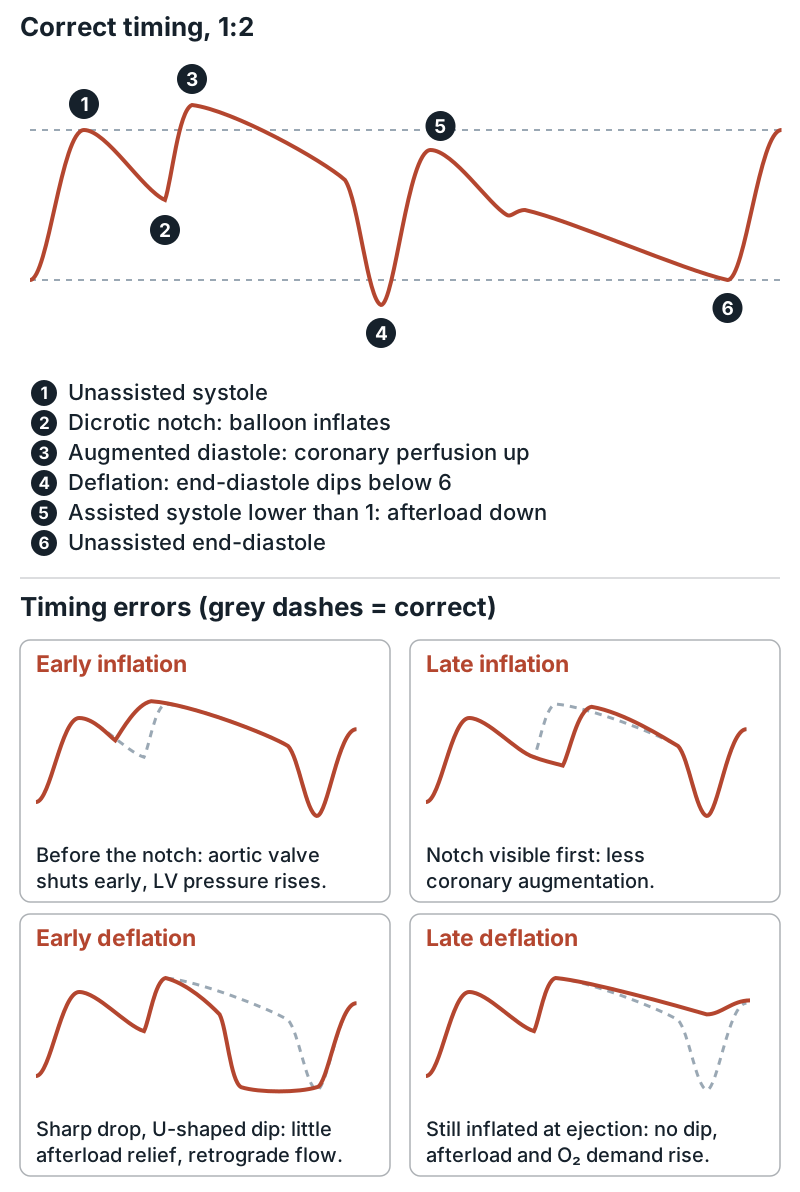
- Balloon position and limbs — tip about 2 cm above the carina; a lost left radial pulse suggests migration over the subclavian.4 Contraindicated with more than mild aortic regurgitation, aortic dissection or aneurysm.5
- Impella — a microaxial pump across the aortic valve; the CP gives up to 4.3 L/min, the 5.5 up to 5.5 L/min.3 It needs heparin or a bicarbonate purge; IABP anticoagulation is optional.2
- Evidence — IABP-SHOCK II showed no 30-day mortality benefit (39.7% vs 41.3%), and ECLS-SHOCK none for VA-ECMO;3 Impella CP in DanGer Shock lowered long-term mortality, at the cost of more bleeding and vascular injury.3
- Heparin targets — anti-Xa-guided monitoring is associated with less bleeding than time-based tests, without more thrombosis.2
Follow-up question
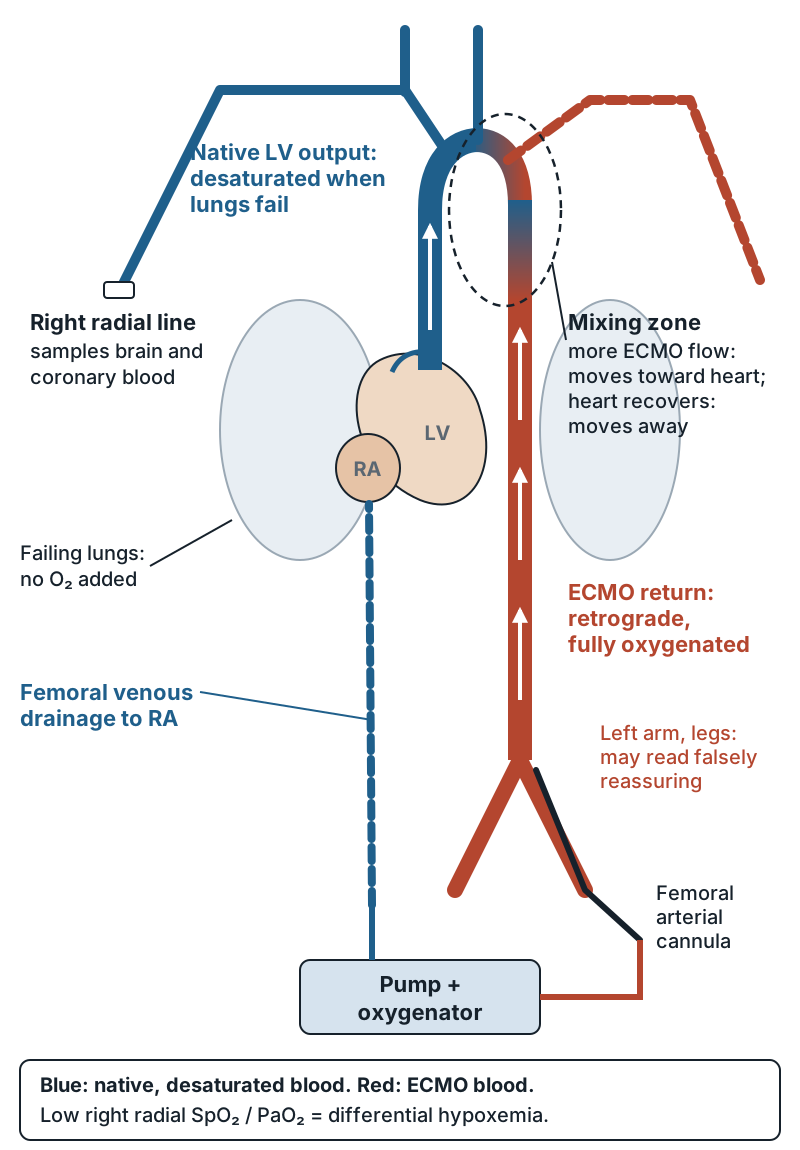
As his heart recovers, the right radial saturation falls to 82% and a right radial gas shows a PaO2 of 48 mmHg, while the femoral arterial line and the circuit post-oxygenator gas are fully saturated. What is happening, and what do you do?
Follow-up answer
HeadlineDifferential hypoxemia, Harlequin syndrome: his recovering heart ejects deoxygenated blood to his head; I tell the ECMO team.
His lungs are failing while his heart wins the mixing zone.1 I raise FiO2 to 1.0 and optimize PEEP and recruitment, ask for higher ECMO flow, about 4.5–5 L/min, to move the mixing zone proximally, and reduce inotropes.1 I add cerebral oximetry. If it persists, the fix is reconfiguration: V-AV ECMO, central return or, once the heart recovers, VV ECMO.1
Pitfalls that cost points
- Reading oxygenation from the left arm or a leg during femoral VA-ECMO.
- Treating low circuit flow with pressors when the venous cannula is sucking an empty cava.
- Changing pump speed or balloon timing without the perfusionist or cardiology team.
Rapid-fire
Q: How much flow does a balloon pump add? A: About 0.5 to 1.0 L/min, and nothing if contractility is absent.3
Q: Which trigger keeps a balloon working during CPR? A: Pressure trigger: the dicrotic notch triggers inflation and the upstroke deflation, so compressions drive it.4
Q: What are the usual complications of VA-ECMO? A: Bleeding, limb ischemia, pump thrombosis, differential hypoxemia, pulmonary edema and sepsis.3
Q: What happens to ECMO recirculation when you add a venous return limb? A: V-AV adds recirculation through the venovenous part, and pushing flow worsens it and hemolysis.1
Numbers to know
| Item | Value |
|---|---|
| IABP added output | ~0.5–1.0 L/min3 |
| IABP tip | ~2 cm above the carina4 |
| Impella CP / 5.5 | Up to 4.3 / 5.5 L/min3 |
| IABP-SHOCK II 30-day mortality | 39.7% vs 41.3%3 |
| ECLS-SHOCK 30-day mortality | 47.8% vs 49.0%3 |
| Harlequin rescue flow | >4.5–5 L/min1 |
Links
- The patient with an LVAD, Cardiopulmonary bypass: conduct and separation, Heart failure and reduced ejection fraction, Vasopressors and inotropes: choosing and titrating, ARDS and lung-protective ventilation
- Atlas: The 11 TEE views
- ELSO guidelines for adult cardiac and respiratory failure; 2024 EACTS/EACTAIC patient blood management guideline
Sources
- 1.Harlequin Syndrome in Venoarterial ECMO and ECPELLA: When ECMO and Native or Impella Circulations Collide - A Comprehensive Review · Reviews in Cardiovascular Medicine (Torre and Pirri), 2025 · ebi.ac.uk
- 2.2024 EACTS/EACTAIC Guidelines on patient blood management in adult cardiac surgery in collaboration with EBCP · EACTS/EACTAIC/EBCP, 2024 · ebi.ac.ukEur J Cardiothorac Surg 2024;ezae352. Section 7.1, temporary mechanical circulatory support.
- 3.Percutaneous Mechanical Circulatory Support Devices in Cardiogenic Shock: A Narrative Review in Light of Recent Evidence · Journal of Clinical Medicine (Paragliola et al.), 2025 · ebi.ac.uk
- 4.The Intra-aortic Balloon Pump: A Focused Review of Physiology, Transport Logistics, Mechanics, and Complications · Journal of the Society for Cardiovascular Angiography & Interventions (Gillespie et al.), 2024 · ebi.ac.uk
- 5.Intra-aortic balloon pump · OpenAnesthesia (IARS), 2026 · openanesthesia.org
Facts on this page were checked against these sources on Oct 22, 2026. Guidelines change; confirm doses against current institutional protocols.