EXIT procedure (ex utero intrapartum treatment)
Stem
A 30-year-old G2P1 at 37 weeks, 72 kg, is carrying a fetus with a large cervical teratoma; fetal MRI shows the trachea displaced and compressed. She is healthy, with a normal airway examination. The plan is an EXIT-to-airway: partial delivery through a hysterotomy, laryngoscopy or bronchoscopy on placental support, and a tracheostomy if intubation fails. Obstetrics, pediatric otolaryngology and neonatology are in the room.
Question
How will you anesthetize the mother and manage the fetus during this procedure?
Ideal answer
HeadlineTwo patients on one placenta: I keep the uterus deeply relaxed and the mother's pressure normal until the fetal airway is secure, then restore uterine tone fast.
- Arterial line, aspiration prophylaxis, rapid sequence general anesthesia, then volatile at about 2–3 MAC, because a relaxed uterus keeps the placenta attached and exchanging gas.1
- Hold maternal pressure within 10% of baseline, with phenylephrine or ephedrine, because placental flow follows her pressure.2,1
- Fetal fentanyl, relaxant and atropine IM, plus fetal pulse oximetry, because maternal agents do not reliably immobilize the fetus or prevent bradycardia.2,3
- Cord clamped: volatile under 0.5 MAC and oxytocin immediately, because atony is her main hemorrhage risk.1,3
Watch for: fetal saturation and heart rate on placental support, and maternal blood loss once the cord is clamped.
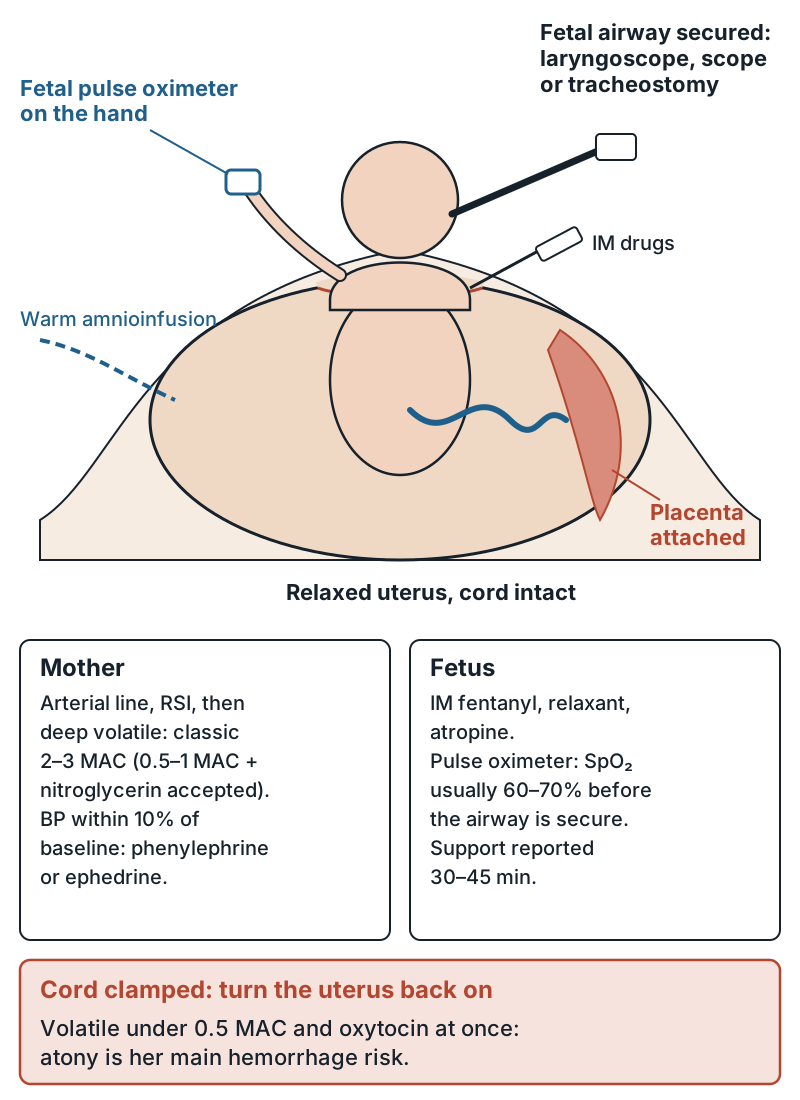
Breaking down the answer
- Who needs EXIT — large neck masses, lung or mediastinal masses, severe diaphragmatic hernia and congenital high airway obstruction.1 Variants are EXIT-to-airway, -ECMO and -resection.2 Changes if: resection on support; the case lasts longer and relaxation must too.
- How deep — the classic plan is deep volatile; 0.5–1.0 MAC is increasingly accepted.2 Changes if: lower MAC or hypotension; I add nitroglycerin, 100 mcg then 0.5–1 mcg/kg/min.1
- Volatile and the fetus — placental transfer reaches 78% in animal data, and fetal MAC is about half the maternal value.1 Changes if: fetal bradycardia; I check maternal pressure and uterine tone first.
- Time on the placenta — the airway stage took about 14 minutes in two cases; reported support lasts 30–45 minutes without fetal compromise.1 Changes if: the placenta separates; the baby is delivered and resuscitated.
- Uterine volume — warmed amnioinfusion, a 300 mL bolus then 10 mL/min, keeps the uterus from contracting down.1 Changes if: the hysterotomy bleeds heavily; the obstetrician controls it before continuing.
- Neuraxial is possible — not contraindicated, but it risks severe hypotension and placental hypoperfusion; most cases use general anesthesia.2,4 Changes if: a difficult maternal airway; neuraxial with nitroglycerin.
Follow-up question
The fetus is intubated, the cord clamped and the baby handed to neonatology. Within five minutes the uterus is boggy, another 1,500 mL is lost, and maternal pressure is 85/45 with heart rate 128. What do you do?
Follow-up answer
HeadlineAtony from my own volatile; I tell the room we are hemorrhaging and turn the uterus back on.
I turn off the volatile and switch to propofol and opioid, call for blood and activate massive transfusion. Oxytocin infusion, then methylergonovine or carboprost unless contraindicated, with the obstetrician compressing the uterus.3 Tranexamic acid 1 g IV at 1 mL/min.5 Pressure with phenylephrine and blood, calcium with the transfusion, fibrinogen and viscoelastic testing. I reassess tone, blood loss and gases every few minutes.
Pitfalls that cost points
- Letting maternal pressure drift while chasing deep relaxation.
- Leaving the volatile on after the cord is clamped.
- No large-bore access or uterotonics ready before hysterotomy.3
Rapid-fire
Q: What fetal intramuscular doses were used in one report? A: Fentanyl 10 mcg/kg, vecuronium 0.2 mg/kg and atropine 100 mcg in 2 mL.2
Q: What fetal saturation is expected before the airway is secured? A: Usually 60–70%, rising once the airway is established.1
Q: How does EXIT differ from mid-gestation open fetal surgery? A: No fluid restriction or magnesium is needed.3
Q: How much blood was lost in two reported cases? A: 1,100 mL and 800 mL, without transfusion.1
Numbers to know
| Item | Value |
|---|---|
| Volatile, classic | Sevoflurane 2–3 MAC; under 0.5 MAC after delivery1 |
| Maternal pressure | Within 10% of baseline2 |
| Nitroglycerin | 100 mcg, then 0.5–1 mcg/kg/min1 |
| Placental support | 30–45 min reported1 |
| Fetal SpO2 before airway | 60–70%1 |
| Amnioinfusion | 300 mL bolus, then 10 mL/min1 |
Links
- Non-obstetric surgery during pregnancy, General anesthesia for cesarean delivery, Obstetric hemorrhage: previa, accreta, atony, Uterotonics and tocolytics, Neonatal physiology and resuscitation
- Kumar et al., systematic review of maternal anesthesia for EXIT (J Anaesthesiol Clin Pharmacol 2019)
Sources
- 1.Two Cases of Ex Utero Intrapartum Treatment (EXIT) in UP-PGH · Acta Medica Philippina, 2016 · actamedicaphilippina.upm.edu.phCase series with discussion: sevoflurane 2-3 MAC, nitroglycerin regimen, amnioinfusion, fetal SpO2, support 30-45 min in the literature.
- 2.Anesthesia for ex utero intrapartum treatment: renewed insight on a rare procedure · Revista Brasileira de Anestesiologia (Marques et al.), 2015 · scielo.brCase report with review: maternal BP within 10% of baseline; 0.5-1 MAC increasingly accepted; fetal IM fentanyl 10 mcg/kg, vecuronium 0.2 mg/kg, atropine 100 mcg.
- 3.EXIT procedure: uterine atony · OpenAnesthesia · openanesthesia.org
- 4.Maternal anesthesia for EXIT procedure: a systematic review of literature · Journal of Anaesthesiology Clinical Pharmacology (Kumar, Miron, Singh), 2019 · doaj.orgJ Anaesthesiol Clin Pharmacol 2019;35(1):19-24, doi:10.4103/joacp.joacp_302_17. Abstract read.
- 5.Joint statement of recommendation for the use of tranexamic acid for the treatment of postpartum haemorrhage · FIGO / ICM, 2021 · figo.org
Facts on this page were checked against these sources on Oct 22, 2026. Guidelines change; confirm doses against current institutional protocols.