Donation after circulatory death: the anesthesiologist's role
Stem
A 46-year-old man, 84 kg, has a severe anoxic brain injury nine days after an out-of-hospital cardiac arrest. He has a gag reflex and intermittent breaths over the ventilator, so he does not meet criteria for death by neurologic criteria. His family decided to withdraw life support, and afterwards authorized donation of his liver and kidneys. He is on norepinephrine 0.04 mcg/kg/min. Withdrawal is planned in the operating room this evening, and you are the anesthesiologist assigned.
Question
What is your role in this case, and what will you do and not do?
Ideal answer
HeadlineThis is controlled donation after circulatory death: he is alive until death is declared. I protect his comfort and the separation of teams, and I never hasten death.
- Confirm the sequence and documents. Withdrawal was decided before donation was raised; authorization, DNR order, premortem-drug consent and examiner clearance are charted.1
- Keep the teams apart. His ICU attending or designee withdraws support and declares death; procurement surgeons stay out of the room and the family's sight.1
- Comfort, titrated to distress. Analgesia and sedation before extubation, repeated for distress, to relieve suffering, never to hasten death.1
- Respect the no-touch period. Death is declared after absent circulation for 2 to 5 minutes; incision follows at once; I reintubate only for a lung team.1
- Plan for survival. No death at one hour: reassess, extend an hour or stop; he leaves for comfort care.1
Breaking down the answer
- Not a brain-dead donor — death by neurologic criteria precedes the OR; here death comes after withdrawal, so the patient-protection rules dominate. Changes if: he meets neurologic criteria before withdrawal; brain-death donor procedures then apply.1
- Separation is conflict-of-interest control — transplant representatives have no role in withdrawal or the declaration, and the OPO's role is limited to location, timing and monitoring.2 Changes if: I am asked to declare; only by prior agreement, never from the procurement side.1
- Premortem interventions need explicit consent — heparin at withdrawal is the current standard, with center-set timing; cannulation, vasodilators and bronchoscopy must be named in the consent.1 Changes if: the consent does not name it; then it is not done.
- Warm ischemia sets the window — for the liver, true warm ischemia (systolic below 50 or SpO2 below 70%) beyond 20–30 minutes is a threshold; kidneys tolerate 45–60 minutes total.3 Changes if: lungs only; the limit is 60 minutes to reinflation.3
- The no-touch period — 2 minutes of mechanical asystole is the ATS minimum;2 many OPOs use 5 to exclude autoresuscitation.4 Changes if: local policy sets 5 minutes; I follow the stricter rule.
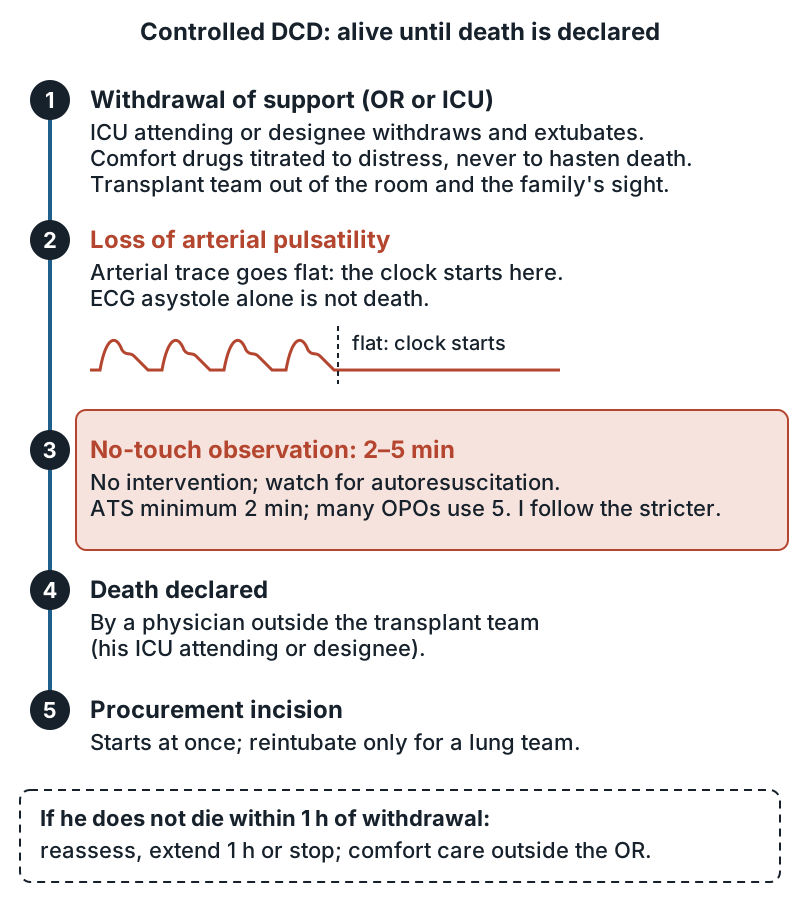
- Normothermic regional perfusion — restores abdominal flow after death with cerebral vessels clamped first; each institution decides, with its anesthesiologists' agreement.1 Changes if: I provide NRP support; then I take no part in end-of-life care or declaration.1
Follow-up question
Twenty minutes after extubation he is gasping, heart rate 132, blood pressure 150/90, and he grimaces. The OPO coordinator says, "Give him a big dose of fentanyl, it'll move things along. The liver team is worried about warm ischemia." What do you do?
Follow-up answer
HeadlineThat is a request to hasten death. I decline it plainly, and I treat his distress because it is real.
I give fentanyl and midazolam in increments titrated to his grimacing, respiratory distress and tachycardia, and I chart each dose with the sign it treated. I tell the coordinator, out of the family's hearing, that dosing follows his comfort, not the graft clock, and that the OPO's role does not include end-of-life care.1 If pressure continues, I involve the ICU attending and the ethics consultant. If he has not died within the agreed window, the donation stops and he returns for comfort care.
Pitfalls that cost points
- Timing death by ECG: the clock starts at loss of arterial pulsatility; monitor asystole is not death until the 2–5-minute observation ends.
- Allowing organ-directed drugs or procedures before death that the consent does not name.
- Any donation-related charge reaching the family.1
Rapid-fire
Q: When must the OPO be notified? A: Within 1 hour of identifying an impending death or a decision to withdraw or limit therapy.2
Q: Can I decline to take part? A: Yes: OR anesthesiologists should not be required to participate in withdrawal or declaration; I arrange cover beforehand.1
Q: Is pediatric DCD acceptable? A: Yes, it is considered ethically reasonable, with guardians deciding.1
Q: How long can the organs then stay cold? A: Liver about 8–10 hours, pancreas 18, kidneys 24, lungs 4–6.3
Q: What happens if he does not die? A: At one hour the team reassesses, extends one more hour or ends donation; comfort care continues outside the OR.1
Numbers to know
| Item | Value |
|---|---|
| Observation before declaration | 2–5 min1 |
| Expected time to death for donation | Usually 60–120 min1 |
| Reassessment after withdrawal | 1 h, extend 1 h or stop1 |
| Liver true warm ischemia | SBP <50 or SpO2 <70%, limit 20–30 min3 |
| Kidney total warm ischemia | 45–60 min3 |
| Heparin circulation before extubation (one OPO) | ≥3 min4 |
Links
- Brain death and the organ donor, Ethical issues: DNR, capacity, surrogates, refusal, Ethical principles reference (ASA guidelines), Liver transplantation
- ASA Statement on Controlled Organ Donation After Circulatory Death (2022); ATS/ISHLT/SCCM/AOPO/UNOS DCDD statement
Sources
- 1.Statement on Controlled Organ Donation After Circulatory Death · ASA Committees on Critical Care Medicine, Ethics and Transplant Anesthesia, 2022 · asahq.orgApproved October 25, 2017; last amended October 26, 2022. Model policy items 1.3, 1.6, 2.1-2.6, 3.1-3.2, 4.5, 5.1-5.6, 6.1-6.4, 7.1.
- 2.An Official ATS/ISHLT/SCCM/AOPO/UNOS Statement: Ethical and Policy Considerations in Organ Donation after Circulatory Determination of Death · American Thoracic Society (Am J Respir Crit Care Med 2013;188:103-109), 2013 · member.thoracic.org
- 3.Organ donation: donation after brain death and donation after cardiac death · OpenAnesthesia (IARS) · openanesthesia.org
- 4.Donation resources for the operating room · Donor Alliance (organ procurement organization) · donoralliance.orgOne OPO's operating-room process; other OPOs differ in detail.
Facts on this page were checked against these sources on Oct 22, 2026. Guidelines change; confirm doses against current institutional protocols.