Pediatric caudal block
Stem
A 3-year-old boy, 15 kg, healthy and born at term, is having day-case repair of bilateral inguinal hernias. He has had a sevoflurane induction, an IV and a laryngeal mask airway, and is breathing spontaneously with a heart rate of 110 and blood pressure 92/50. The surgeon asks for a caudal block before incision.
Question
How will you perform the caudal, what will you inject, and how will you keep it safe?
Ideal answer
HeadlineLateral position, single-shot caudal before incision: ropivacaine 0.2%, 1 mL/kg (15 mL, 2 mg/kg), injected only after an epinephrine test dose is negative.
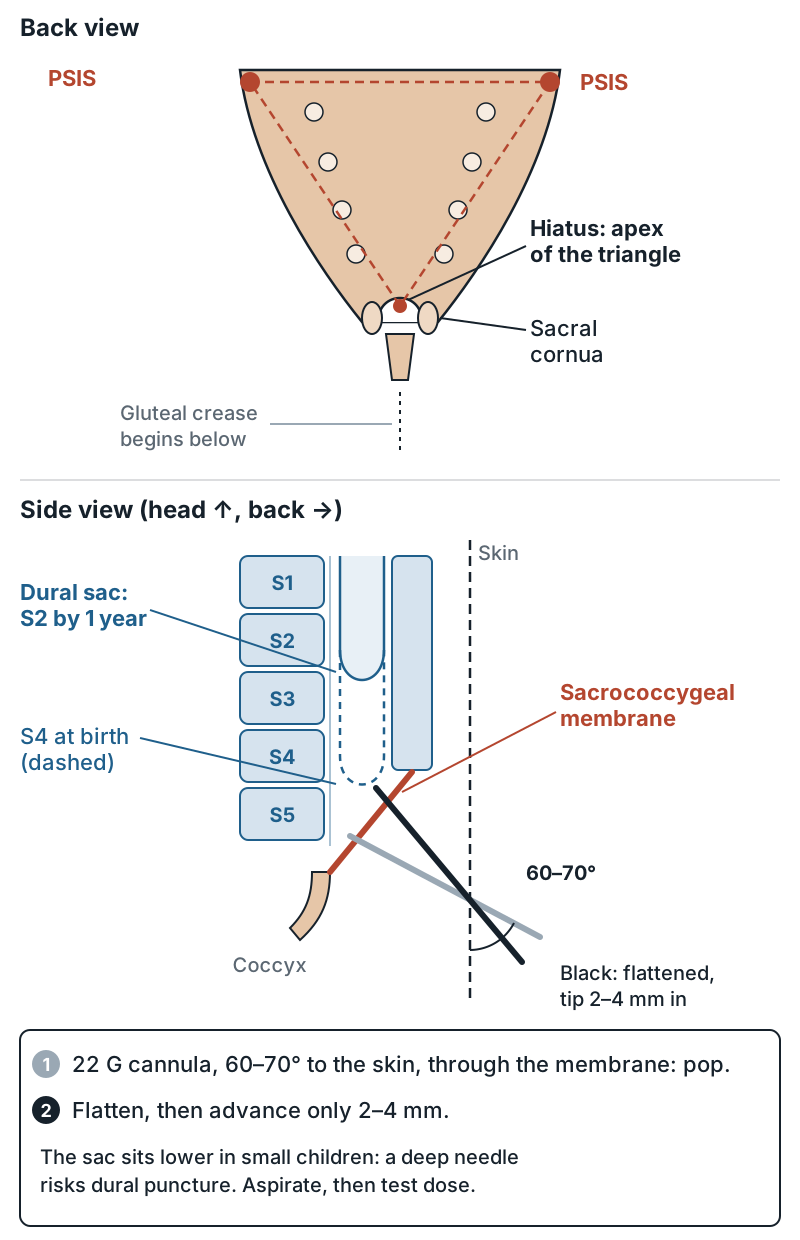
- Find the hiatus between the cornua, the apex of a triangle with the posterior superior iliac spines, above the gluteal crease.1,2
- 22-gauge cannula at about 60–70°, through the membrane, then flatten and advance only 2–4 mm, because the dural sac sits lower in small children.1,2
- Aspirate, then epinephrine 0.5 mcg/kg test dose, watching T waves, ST segments and pressure, because tachycardia is unreliable under general anesthesia.1
- Inject slowly over 2–3 minutes, aspirating every 3–5 mL with the ECG in view.1
Watch for: peaked T waves, ST change or a pressure jump during injection: stop immediately.
Breaking down the answer
- Volume sets the height — Armitage (1979): 0.5 mL/kg sacral and lumbosacral; 1.0 mL/kg lumbar to lower thoracic, about T10 for inguinal surgery; 1.25 mL/kg higher.3 Changes if: mid-thoracic surgery; I place a catheter rather than push volume.
- Dose ceilings — bupivacaine 2.5 mg/kg in children and 1.5 mg/kg in neonates; caudal ropivacaine at most 2 mg/kg.2,4 Pediatric dosing rests on limited high-level evidence.5 Changes if: a neonate; infants have higher free drug levels, so I dose lower.1
- Anatomy by age — conus at L3 at birth and L1 by a year; dural sac at S4 at birth and S2 by a year.1 Changes if: a sacral dimple or anomaly, present in about 10%; I image first or choose another block.2
Ultrasound in a newborn: cornua, sacrococcygeal ligament, needle in the canal.
- Reading the test — T-wave amplitude rising over 25%, ST change or pressure rise mean intravascular;1 a heart rate rise of 10 bpm also predicts it.2 Changes if: positive; I stop and switch to a TAP or ilioinguinal block.
- Adjuncts — clonidine 1–2 mcg/kg prolongs analgesia at the cost of sedation; fentanyl adds side effects without benefit in a single shot; caudal ketamine is not approved in the US.2 Changes if: a former preterm infant; I skip clonidine for apnea risk.
- Who gets one — children under about 8 years having abdominal or lower-limb surgery.1 Changes if: older and heavier; volumes become impractical, so I use lumbar epidural or peripheral blocks.
Follow-up question
The test dose was negative, but after 5 mL of the main injection the T waves become tall and peaked, heart rate climbs from 110 to 150 and then widens into a broad-complex rhythm, and the blood pressure falls to 60/30.
What do you do?
Follow-up answer
HeadlineIntravascular injection with local anesthetic cardiotoxicity; I stop injecting, call for help and say "LAST" to the room.
I secure the airway with a tube, 100% oxygen and normal ventilation. I give 20% lipid 1.5 mL/kg over 2–3 minutes, about 22 mL, then 0.25 mL/kg/min,6 repeating the bolus up to twice; total no more than 12 mL/kg.7 Pulseless, CPR with epinephrine reduced to 1 mcg/kg or less; amiodarone for arrhythmia; no vasopressin, calcium-channel or beta-blockers, or lidocaine.8 I alert the bypass or ECMO team early.8 Seizures get a benzodiazepine.7
Pitfalls that cost points
- Relying on heart rate alone to read the test dose.
- Injecting the full volume in one rapid push.
- Choosing 0.25% bupivacaine at 1.25 mL/kg without calculating the milligram dose.
Rapid-fire
Q: What is the "pop" you feel? A: The needle crossing the sacrococcygeal membrane into the caudal epidural space.1
Q: How can a stimulating needle confirm placement? A: An anal sphincter twitch at 1–10 mA.1
Q: What alternative volume rule exists? A: Takasaki: 0.06 mL per segment per kg.2
Q: Where can the injectate go wrong besides a vein? A: Into bone, subcutaneous tissue or the intrathecal space.2,1
Numbers to know
| Item | Value |
|---|---|
| Armitage volumes | 0.5 sacral; 1.0 lumbar to ~T10; 1.25 mL/kg higher3 (dilute so ropivacaine stays ≤2 mg/kg) |
| Bupivacaine maximum | 2.5 mg/kg child; 1.5 mg/kg neonate2 |
| Ropivacaine maximum, caudal | 2 mg/kg (ESRA/ASRA 2018)4 |
| Test dose | Epinephrine 0.5 mcg/kg1 |
| Clonidine adjunct | 1–2 mcg/kg2 |
| Dural sac / conus at birth | S4 / L31 |
| Lipid 20% bolus | 1.5 mL/kg; maximum ~12 mL/kg7,8 |
Links
- Local anesthetic systemic toxicity, Epidural anesthesia and the test dose, The former premature infant and postoperative apnea, Transversus abdominis plane, Ambulatory anesthesia and discharge criteria
- ESRA/ASRA recommendations on local anesthetic dosing in pediatric regional anesthesia (2018); ASRA checklist for local anesthetic systemic toxicity (2020)
Sources
- 1.Pediatric regional anesthesia (chapter 30) · Defense and Veterans Center for Integrative Pain Management, USUHS, 2025 · dvcipm.usuhs.eduTable 30-1 anatomy by age; caudal technique; test dose criteria under GA; Table 30-2 concentrations and volumes.
- 2.Pediatric Acute Pain Management (teaching slides) · Stanford Pediatric Anesthesia, 2023 · med.stanford.eduArmitage volumes, maximum doses, adjuncts, test-dose predictors.
- 3.Pediatric Epidural and Spinal Anesthesia and Analgesia · NYSORA · nysora.comCaudal volumes by level (Armitage, Anaesthesia 1979): 0.5 mL/kg sacral, 1.0 mL/kg high lumbar (T10 possible), 1.25 mL/kg low thoracic; bupivacaine max 2.5 mg/kg.
- 4.Recomendaciones ESRA/ASRA en anestésicos locales y adyuvantes empleados en la población pediátrica · Revista Electrónica de AnestesiaR (critical summary of the 2018 ESRA/ASRA recommendations), 2019 · dialnet.unirioja.esSpanish-language summary of the full 2018 recommendations: caudal ropivacaine 0.2% or bupivacaine 0.25% not to exceed 2 mg/kg ropivacaine or 2.5 mg/kg bupivacaine (evidence B2); lumbar or thoracic epidural maximum 1.7 mg/kg.
- 5.ESRA/ASRA Recommendations on Local Anesthetics and Adjuvants Dosage in Pediatric Regional Anesthesia · Regional Anesthesia and Pain Medicine (Suresh et al.), 2018 · rapm.bmj.comAbstract only was readable: high-level evidence for pediatric dosing is lacking.
- 6.Checklist for Treatment of Local Anesthetic Systemic Toxicity (LAST) · ASRA Pain Medicine, 2020 · asra.com
- 7.Management of Severe Local Anaesthetic Toxicity (safety guideline) · AAGBI, 2010 · rcoa.ac.ukWeight-based lipid regimen; the 2020 ASRA checklist uses the same 1.5 mL/kg initial bolus.
- 8.Local Anesthetic Systemic Toxicity (LAST), summarizing the ASRA LAST checklist 2020 · UCSF Pain Management, 2020 · pain.ucsf.edu
Facts on this page were checked against these sources on Oct 22, 2026. Guidelines change; confirm doses against current institutional protocols.